What Cleanroom Manufacturing Means for Supplement Quality and Risk Control
A practical explanation of why cleanroom standards matter for supplement brands evaluating manufacturing quality.

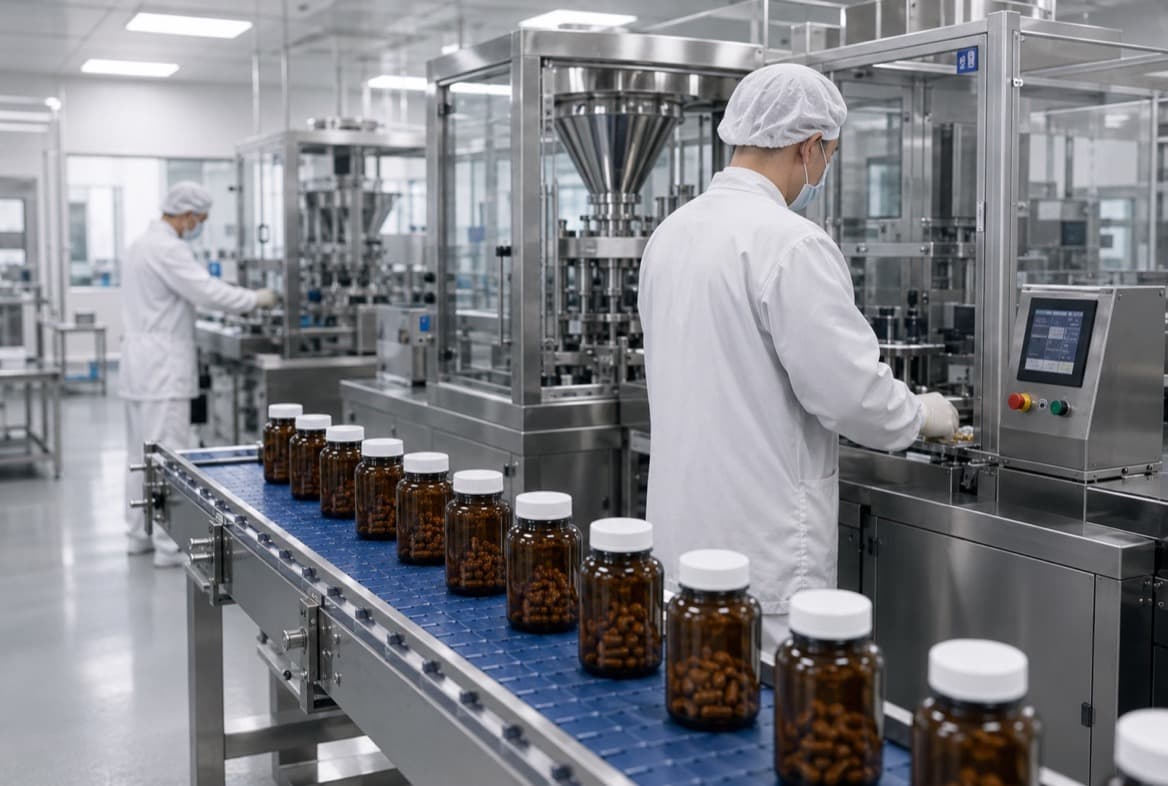
Cleanroom manufacturing is often mentioned in supplement industry marketing, but for serious brands, the phrase only matters if it translates into better environmental control, lower contamination risk, and more consistent production outcomes. In practical terms, that means looking beyond the label and understanding how the manufacturing environment affects the product itself. RiverPharm publicly highlights pharmaceutical-grade cleanroom production, ISO 7 / Class 10,000 positioning on its homepage, and climate-controlled production conditions in at least one probiotic case study. Those details matter because environmental control can directly influence formula stability and process consistency.
For buyers evaluating a supplement manufacturer, cleanroom claims should be understood as an operational question: how does this environment protect product quality?
Who this article is for
This article is for supplement brands that:
care about contamination control and production consistency
are evaluating a U.S. contract manufacturer
produce powders, capsules, probiotics, or sensitive blends
want stronger quality-system visibility before qualification
1. Cleanroom Control Is About More Than Clean Appearance
A clean-looking facility is not the same thing as a controlled manufacturing environment.
What matters is not whether the room looks polished during a tour. What matters is whether the environment is managed in a way that reduces:
airborne contamination
cross-contact risk
unnecessary particulate exposure
humidity-related formula issues
variability caused by unstable conditions
RiverPharm frames its environment around ISO 7 / Class 10,000 cleanroom control and “airborne particles strictly controlled,” which is exactly the kind of operational language buyers should focus on instead of vague cleanliness claims.
2. Why Environmental Control Matters for Supplement Products
Not all supplement products are equally sensitive, but many are affected by production conditions more than brands initially realize.
Environmental control can matter for:
powder flow consistency
capsule fill behavior
moisture-sensitive ingredients
probiotic stability
cross-contamination prevention between products
overall repeatability from batch to batch
This is one reason experienced buyers evaluate the environment not as a separate quality story, but as part of manufacturability and product protection.
3. Sensitive Formulas Require More Discipline
Some formulas are more forgiving than others. Others are not.
For example, probiotics and moisture-sensitive ingredients may require tighter humidity control and more disciplined handling conditions. RiverPharm’s probiotic case study specifically describes delayed-release HPMC capsules being manufactured under RH below 20% with nitrogen flushing, with the stated result of 24-month shelf stability and greater than 95% intestinal survivability. Whether or not a brand needs that exact process, it is a strong example of how environmental control can be tied to a formulation outcome rather than just a marketing phrase.
When a manufacturer can explain why an environment matters for a specific formula, that is usually more meaningful than simply showing a certification graphic.
4. Cleanroom Standards Also Support Risk Reduction
From a buyer’s perspective, cleanroom discipline is partly about product quality and partly about brand protection.
If environmental control is weak, the risk is not limited to technical inconsistency. It can also affect:
complaint rates
perceived quality
retailer confidence
reformulation pressure
internal QA workload
reputational exposure
As brands grow, even small quality variation can become more visible and more expensive. That is why environmental control matters more as volume and visibility increase.
5. What Buyers Should Verify During Qualification
If a manufacturer highlights cleanroom production, do not stop at the headline. Ask operational questions such as:
What cleanroom standard is being maintained?
How is airborne particulate controlled?
How is humidity managed when formulas are sensitive?
What segregation practices reduce cross-contact risk?
Which products truly require tighter environmental conditions?
How does the production team monitor and document those conditions?
A strong manufacturer should be able to answer these clearly and without relying on generic marketing language.
6. Cleanroom Control and Scale Can Work Together
Some buyers assume that tighter environmental control comes at the expense of production speed. In reality, sophisticated manufacturers are expected to manage both.
RiverPharm publicly combines claims around cleanroom production with high-speed equipment, in-house testing, and large-volume capsule output, which reflects the broader expectation from modern B2B buyers: quality systems should support scale, not slow it down.
That combination matters because growing brands rarely want to choose between speed and control. They want a manufacturing system capable of both.
7. When Cleanroom Manufacturing Matters Most
Cleanroom control becomes especially relevant when:
the formula is sensitive to humidity or oxygen
the brand is positioning itself as premium
repeatability matters across large batch counts
multiple products are being manufactured in proximity
channel partners expect stronger quality documentation
the business cannot afford avoidable inconsistency
In those cases, the environment is not a side detail. It is part of the product strategy.
Final Thoughts
Cleanroom manufacturing only has value if it improves real-world control.
For supplement brands, the right question is not whether a manufacturer uses the term. The right question is whether the environment is managed in a way that protects your product, supports consistency, and reduces operational risk as you scale.
That is what turns a cleanroom from a brochure claim into a useful manufacturing asset.
CTA
Need a manufacturing partner with tighter environmental control for capsules, powders, or sensitive formulations? RiverPharm can review your product requirements and discuss facility fit, process conditions, and production readiness.
Hot Tags: apple cider vinegar capsules with the mother, apricot seed extract capsules, ashwagandha capsules for weight loss, beauty whitening capsule, bee pollen capsules for weight loss, beet extract capsules, best apple cider vinegar capsule, capsulas de turmeric, curcumin turmeric capsules, fiber capsules psyllium husk, fiber psyllium capsule, fiber supplement capsule, fusion plus iron capsules, glp-1 boost capsules, custom, private label, manufacturing company, manufacturers, suppliers, factory, Customized, Bulk, quotation, oem, contract manufacturing, manufacturer, b2b manufacturing, gmp certified manufacturing
Did you find this helpful?
Comments (0)
No comments yet. Be the first to comment!
Leave a comment
Related Posts

Riverpharm · Supplement Contract Manufacturing
Your supplement brand, manufactured to the highest standard
From first formula to finished product — we handle manufacturing, packaging, and fulfillment so you can focus on building your brand.
Core services
Contract Manufacturing
GMP-certified production with full batch testing and certificate of analysis on every run.
Custom Formulation & R&D
In-house scientists develop your formula from scratch or refine existing blends for efficacy.
Packaging & Labeling
Design-to-print label service — shelf-ready, FDA-compliant, and retail-tested.
FBA Prep & Fulfillment
Amazon-ready prep and direct-to-warehouse shipping — no extra steps on your end.
By the numbers
NSF
NSF/ANSI 455-2 certified
cGMP
Certified environment
24 hr
AI-accelerated quote turnaround
600K
cGMP+ encapsulator capacity per run
Why Riverpharm
Quality systems with higher standards
- NSF/ANSI 455-2 certified
- cGMP-certified environment
- In-house + third-party testing
- Source-locked ingredients
Production capacity with faster execution
- Heavy-duty hardware
- In-house core reserves
- AI-accelerated quotes
- In-house expert hub
Delivery formats we produce
Capsules
Gelatin & HPMC vegetarian
Sachets
Single-dose powder blends
Stick packs
Convenient single-serve
Pouches
Flexible, shelf-ready
Ready to bring your supplement to market?
Free consultation · 24-hour quote · No minimum commitment to get started