Scaling a Capsule Formula Without Losing Fill Accuracy or Stability
A scale-up guide for brands moving capsule products from smaller runs to commercial volume.

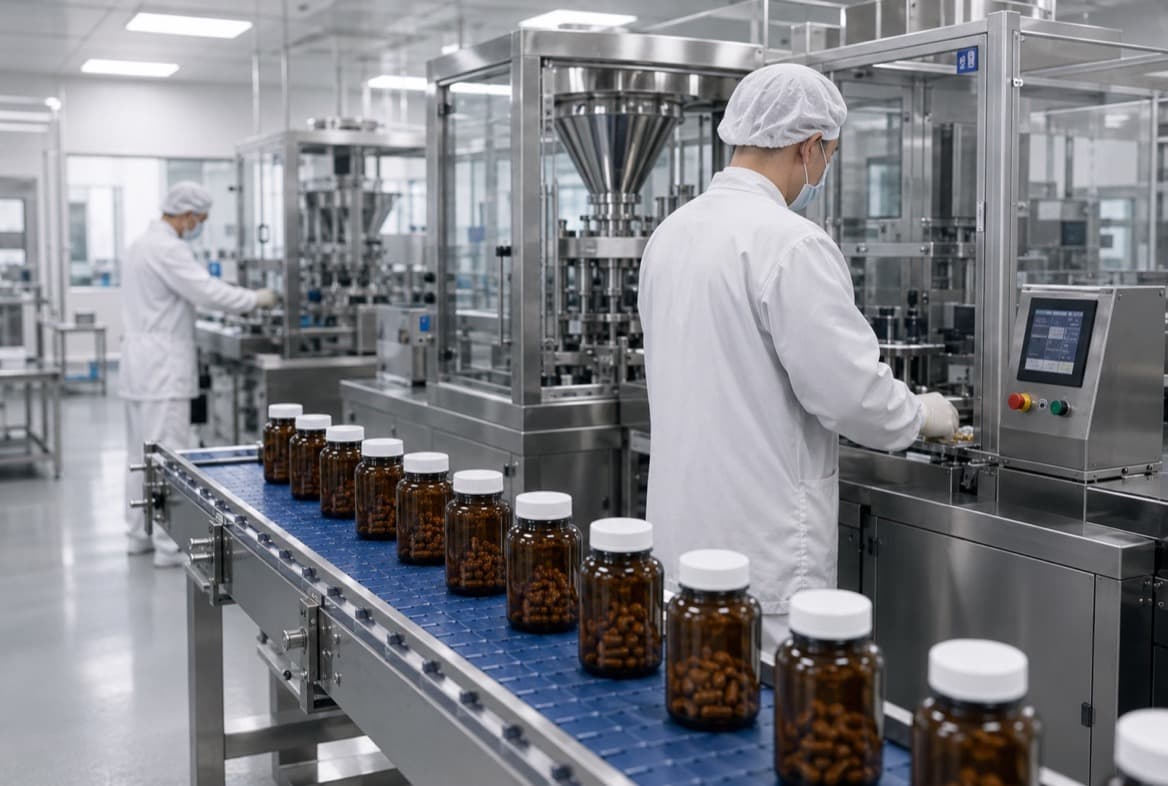
Scaling a capsule formula is one of the most important transitions a growing supplement brand can make. A formula that performs well in smaller production runs does not automatically behave the same way at commercial volume. As order size increases, even minor issues in powder flow, blend uniformity, excipient balance, or environmental sensitivity can create noticeable differences in fill consistency and product performance. For brands with strong channel exposure, those differences can become quality problems very quickly. RiverPharm publicly positions capsule manufacturing as a core capability, highlights high-speed encapsulation, and frames its facility around tighter environmental and quality controls, which makes this topic highly relevant for brands moving from smaller-scale execution into broader commercial growth.
In simple terms, capsule scale-up succeeds when three things remain stable as volume increases:
the blend behaves consistently
the fill weight stays controlled
the finished product holds its intended stability profile
Who this article is for
This guide is for supplement brands that:
already have a working capsule formula
are preparing for higher-volume manufacturing
need stronger consistency across larger batch counts
want to protect performance while scaling distribution
1. Pilot Success Does Not Guarantee Commercial Success
One of the most common misunderstandings in supplement manufacturing is assuming that a successful pilot or smaller batch automatically proves full-scale readiness.
At low volume, a formula may appear stable because process variation is easier to control. At higher volume, however, brands may encounter:
less predictable powder flow
fill-weight drift
inconsistent blend behavior
line-speed sensitivity
increased exposure to humidity-related issues
That is why scale-up should be treated as a technical transition, not just a purchasing step.
2. Blend Behavior Matters More Than Many Brands Realize
Before a capsule ever reaches the fill machine, the blend itself has to behave predictably.
Capsule formulas may become difficult to scale when they involve:
fine or poorly flowing powders
multi-ingredient blends with uneven density
low-dose actives that require strong uniformity control
moisture-sensitive ingredients
excipient systems that worked in one setting but not another
A formula that looks right on paper can still become operationally unstable if the powder does not move through equipment consistently. That is why manufacturability review matters before brands commit too confidently to larger-volume production.
3. Fill Accuracy Is an Operational Quality Signal
As scale increases, fill accuracy becomes one of the clearest signs of whether the process is truly under control.
For buyers, this matters because fill variation is not just a factory issue. It can affect:
label-claim confidence
product consistency
QA review burden
channel trust
customer perception of quality
RiverPharm publicly ties its capsule platform to high-speed encapsulation and in-house plus third-party verification, which reflects the broader expectation that commercial-scale capsule programs need both throughput and disciplined quality control.
4. Excipients and Machine Compatibility Can Change the Outcome
A capsule formula does not exist independently from the equipment that runs it.
As volume increases, brands should revisit questions such as:
Does the excipient system still support stable flow at higher speed?
Is the capsule shell type the best fit for this formula?
Will higher throughput expose weaknesses in blend handling?
Does the formula require tighter environmental conditions?
Even when the active ingredients stay the same, the surrounding system may need refinement to protect consistency at larger scale.
5. Stability Depends on Process, Not Just Ingredients
Many brands think of stability only in terms of formula composition. In reality, the production environment can play a major role.
That becomes especially important for:
probiotic formulas
moisture-sensitive blends
oxygen-sensitive actives
delayed-release capsule programs
products expected to hold performance over long shelf periods
RiverPharm’s public probiotic case study describes using delayed-release HPMC capsules under RH below 20% with nitrogen flushing, with the reported result of 24-month shelf stability and greater than 95% intestinal survivability. This is a useful example of how stability can depend on manufacturing conditions as much as on ingredient selection alone.
6. Environmental Control Supports Repeatability
A manufacturer’s environment matters more as product sensitivity and brand visibility increase.
Capsule scale-up becomes more reliable when the facility can control factors such as:
airborne particulate exposure
humidity
cross-contact risk
process consistency from batch to batch
RiverPharm publicly presents ISO 7 / Class 10,000 cleanroom positioning and stricter particle-control claims as part of its production story, which fits the broader buyer concern that scale should not come at the expense of control.
7. Questions to Ask Before Scaling a Capsule Formula
Before moving a capsule product into larger-volume production, ask your manufacturing partner:
Has this formula been reviewed specifically for scale-up behavior?
What could affect fill consistency at higher throughput?
Does the blend require excipient adjustment?
Are humidity or environmental factors important here?
Would you recommend a technical pilot before full commercial release?
How are fill accuracy and batch consistency monitored?
These questions help separate true commercial readiness from optimistic assumptions.
8. When a Technical Pilot Still Makes Sense
Not every capsule formula needs a major redevelopment step. But some still benefit from a controlled technical run before full-scale commitment.
This is especially true when:
the formula includes challenging powders
the original process came from a different factory setup
the product has premium or performance positioning
shelf stability is commercially important
the brand cannot afford a delayed launch or quality drift
A short validation step may save far more time and money than a rushed full-scale batch that exposes preventable issues.
Final Thoughts
Scaling a capsule formula successfully is not about running the same product faster. It is about making sure the formula, the process, the environment, and the quality controls still work together when commercial pressure increases.
For serious supplement brands, that is what protects both product integrity and growth momentum.
CTA
Need to scale an existing capsule formula without compromising fill consistency or stability? RiverPharm can review your formula, capsule type, environmental needs, and projected volume to help determine the right production path.
Hot Tags: glucomannan plus fibre appetite suppressant capsules, maca plus capsules, mulberry leaf extract capsules, nitric oxide booster capsules, organic weight loss capsules, papaya leaf extract capsules, pomegranate extract capsules, turmeric capsules weight loss, turmeric curcumin capsule, turmeric extract capsules, turmeric in capsule form, turmeric supplement capsules, custom, private label, manufacturing company, manufacturers, suppliers, factory, Customized, Bulk, quotation, oem, contract manufacturing, manufacturer, b2b manufacturing, gmp certified manufacturing
Did you find this helpful?
Comments (0)
No comments yet. Be the first to comment!
Leave a comment
Related Posts

Riverpharm · Supplement Contract Manufacturing
Your supplement brand, manufactured to the highest standard
From first formula to finished product — we handle manufacturing, packaging, and fulfillment so you can focus on building your brand.
Core services
Contract Manufacturing
GMP-certified production with full batch testing and certificate of analysis on every run.
Custom Formulation & R&D
In-house scientists develop your formula from scratch or refine existing blends for efficacy.
Packaging & Labeling
Design-to-print label service — shelf-ready, FDA-compliant, and retail-tested.
FBA Prep & Fulfillment
Amazon-ready prep and direct-to-warehouse shipping — no extra steps on your end.
By the numbers
NSF
NSF/ANSI 455-2 certified
cGMP
Certified environment
24 hr
AI-accelerated quote turnaround
600K
cGMP+ encapsulator capacity per run
Why Riverpharm
Quality systems with higher standards
- NSF/ANSI 455-2 certified
- cGMP-certified environment
- In-house + third-party testing
- Source-locked ingredients
Production capacity with faster execution
- Heavy-duty hardware
- In-house core reserves
- AI-accelerated quotes
- In-house expert hub
Delivery formats we produce
Capsules
Gelatin & HPMC vegetarian
Sachets
Single-dose powder blends
Stick packs
Convenient single-serve
Pouches
Flexible, shelf-ready
Ready to bring your supplement to market?
Free consultation · 24-hour quote · No minimum commitment to get started