Batch Consistency vs. Rapid Prototyping: Solving the Scaling Issues in Custom Supplement Formulation
Explore how rapid prototyping and batch consistency work together to scale custom supplement formulas across capsules, sachets, stick packs, and pouches.

In custom supplement formulation, batch consistency and rapid prototyping can appear to compete with each other. Brands want a fast path from an ingredient concept or benchmark product to a market-ready capsule, stick pack, sachet, or soft pouch. At the same time, every commercial batch must deliver the intended identity, purity, strength, composition, and packaging performance.
For River Pharm Inc., these goals should be managed as connected stages—not as a choice between speed and control. Rapid prototyping helps a brand learn early. Batch consistency proves that the chosen formula can be reproduced reliably as production volume grows. The strongest custom supplement manufacturing program builds speed into development while protecting quality through documented specifications, controlled manufacturing, and lot-level review.

Why Scaling a Custom Formula Is Difficult
A supplement formula that performs well in a small development trial may behave differently during full-scale manufacturing. This is especially true when brands request custom blends with botanical extracts, probiotics, vitamins, minerals, amino acids, fibers, flavor systems, sweeteners, or functional excipients.
At prototype scale, a formulation team can make quick adjustments to taste, color, flowability, capsule fill weight, powder density, moisture response, or dispersibility. Commercial manufacturing introduces more variables:
- Larger ingredient lots may show natural variation in particle size, bulk density, color, odor, or moisture.
- Longer blending and filling times can affect blend uniformity, segregation risk, and output consistency.
- Different packaging formats can change the formula's requirements for flow, fill accuracy, oxygen protection, moisture barrier, and seal integrity.
- Higher production volumes require repeatable equipment settings, validated procedures, material controls, and clear release criteria.
- Complex formulas may have competing technical needs, such as high active loading but limited capsule space, or strong flavors in a low-dose stick pack.
The critical point is simple: a prototype is an evidence-generating stage, not automatically a production-ready formula. A formula becomes scalable only when it can meet written specifications repeatedly under defined production conditions.
FDA dietary supplement current good manufacturing practice requirements are built around this principle. Manufacturers must establish specifications and controls that help ensure each finished product meets requirements for identity, purity, strength, composition, and contamination limits. FDA also requires complete batch production records for each manufactured batch.
Batch Consistency: The Commercial Foundation
Batch consistency means that each released lot performs within predefined and documented quality parameters. It is not merely a visual comparison between two batches, and it is not limited to whether a capsule looks the same from one production run to another.
For a custom supplement brand, consistent manufacturing means the product that reaches the market remains aligned with the approved formula, intended dosage form, label declaration, quality specifications, and packaging requirements.
What Batch Consistency Actually Covers
A robust batch-consistency program should address the product across the full production journey:
- Raw material identity: Confirming that incoming materials match the approved ingredient specification.
- Raw material quality: Reviewing relevant documentation and testing or examination results before use.
- Formula accuracy: Verifying that the right materials are added in the approved amounts.
- Blend uniformity: Assessing whether active ingredients are distributed consistently throughout the mixture.
- In-process control: Monitoring key steps such as weighing, blending, encapsulation, filling, sealing, and packaging.
- Finished-product conformance: Checking whether the final product meets established specifications.
- Packaging integrity: Ensuring that sachets, stick packs, soft pouches, and other formats are correctly filled, sealed, and labeled.
- Documentation and traceability: Maintaining a complete history of what occurred during each specific batch.
In U.S. dietary supplement manufacturing, the master manufacturing record defines how a product is intended to be produced, while the batch production record documents how a particular batch was actually produced. FDA guidance states that batch production records must include complete information relating to the production and control of each batch, and they must accurately follow the applicable master manufacturing record.
Why Consistency Matters to Growing Brands
When a brand moves from a pilot run to recurring production, inconsistency can create costs far beyond a rejected batch. It can lead to delayed launches, customer complaints, label-risk questions, inventory disruption, retailer concerns, or a difficult reformulation after a product has already gained market traction.
A consistent product also protects a brand's commercial promise. If a customer repurchases a sleep-support capsule, hydration stick pack, collagen sachet, or wellness powder, they expect a similar experience in flavor, fill level, appearance, and use.
For this reason, the question is not simply, "Can this formula be made?" The stronger question is:
> Can this formula be manufactured repeatedly, in the selected format, at the required scale, while meeting defined quality specifications?
Rapid Prototyping: Faster Learning Before Production
Rapid prototyping is a structured formulation-development approach that produces early versions of a supplement so the brand and manufacturing team can test assumptions before committing to full-scale production.
For River Pharm Inc.'s custom ODM service, the starting point may be a reference product, a desired ingredient list, a target benefit direction, a dosage format, or a packaging concept. The R&D team then evaluates whether that concept can become a practical, manufacturable product.
This is not private-label production using a standard public formula. It is a custom development process in which the formula must be assessed for technical feasibility, ingredient compatibility, manufacturability, quality requirements, and commercial fit.
What a Prototype Should Answer
A meaningful supplement prototype should answer practical questions early:
- Can the target actives fit into the chosen capsule, sachet, stick pack, or pouch format?
- Does the blend flow consistently through commercial equipment?
- Will the formula segregate during handling or filling?
- Does the powder clump, bridge, absorb moisture, or create dusting challenges?
- Can the product meet reasonable sensory expectations, where taste and texture are relevant?
- Are there ingredient interactions that may affect stability, appearance, odor, or potency?
- Does the intended packaging provide adequate protection for the formula?
- Is the proposed formula commercially realistic at the desired production volume?
Recent industry coverage has emphasized that delivery-format selection should occur earlier in product development because ingredients must be evaluated not only for bioactivity but also for format flexibility and sensory performance.
Speed Is Not the Same as Skipping Validation
A rapid development cycle should reduce avoidable uncertainty. It should not bypass the work necessary to make a formula dependable.
For example, a brand may request a high-dose botanical-and-mineral stick pack based on an existing market reference. The prototype may initially meet the desired flavor profile but show poor powder flow or inconsistent filling behavior. Rather than proceeding immediately to production, the development team may need to review the ingredient grade, particle size, excipient strategy, flavor system, order of addition, blend time, or packaging choice.
That adjustment can feel slower in the moment. In practice, it is usually faster than discovering the issue after raw materials have been committed for a large commercial order.
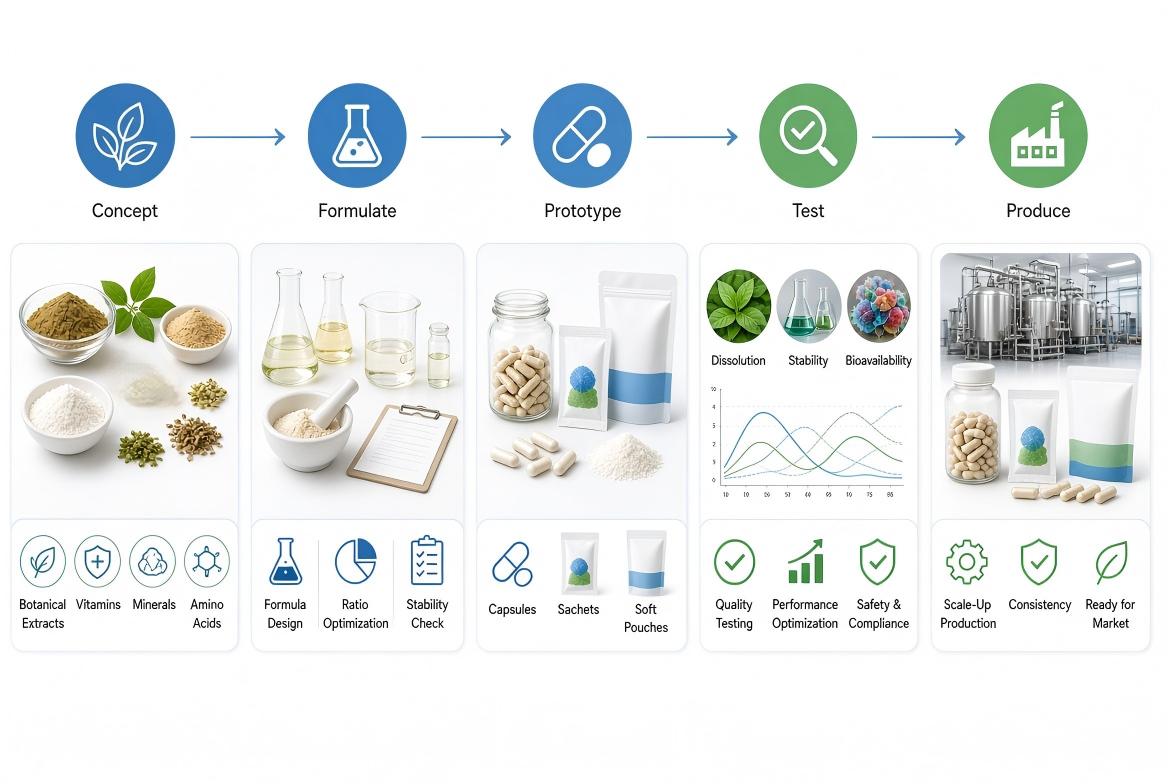
The Scale-Up Bridge: From Prototype to Production
The most common scaling issue is treating a successful prototype as though it already contains all the information needed for commercial manufacturing. A prototype can prove feasibility, but scale-up requires process definition.
At River Pharm Inc., the handoff from R&D to production should be treated as a formal bridge. The formula, process, packaging format, and quality expectations need to be translated into controlled manufacturing instructions.
A Practical Five-Step Scale-Up Process
1. Define the product brief clearly.
Align on dosage form, serving size, target ingredients, packaging format, reference product expectations, label requirements, target markets, and forecasted volume.
2. Assess formula feasibility.
Review active load, ingredient compatibility, powder flow, density, sensory requirements, moisture sensitivity, and expected processing challenges.
3. Develop and refine prototypes.
Produce trial versions that test the formula in the intended format. For example, a capsule formula should be assessed differently from a drink-mix stick pack or a soft pouch powder.
4. Create production-ready specifications.
Establish approved ingredient requirements, formula version control, processing instructions, in-process checks, finished-product criteria, and packaging standards.
5. Execute controlled commercial production.
Manufacture according to the approved master manufacturing record, create a complete batch production record, complete quality review, and release only after the batch meets established requirements.
This process supports faster scaling because it prevents teams from making unrecorded adjustments during production. A change in ingredient grade, blend order, flavor system, capsule shell, pouch material, or fill weight may have a direct effect on product performance. Those changes need to be assessed and controlled—not treated as routine substitutions.
How Quality Control Protects Custom Formulas
Quality control is not a final checkpoint at the end of manufacturing. It is a decision-making function that begins before ingredients enter production and continues through final release.
FDA's cGMP framework requires specifications for each component and finished dietary supplement. It also requires controls and appropriate testing or examination to determine whether those specifications have been met. The American Medical Association's Journal of Ethics similarly notes that requirements include specifications for identity, purity, strength, composition, and limits on contaminants, with scientifically valid methods used to verify compliance.
Critical Control Areas
For custom supplement manufacturing, quality control should have visibility across these areas:
- Supplier and material qualification: Incoming ingredients should be evaluated against the approved specification before they are used in a custom formula.
- Formula-version control: Production must use the current approved formula, not an outdated prototype or an informal spreadsheet revision.
- Accurate dispensing: Each ingredient must be weighed and recorded according to the manufacturing record.
- Equipment readiness: Equipment cleaning, maintenance, and calibration status should be controlled before production begins.
- In-process verification: Parameters such as blend time, capsule weight, pouch fill, seal performance, and appearance should be checked as defined by the process.
- Finished-product review: The completed lot should be evaluated against established product specifications before release.
- Traceability: Records should connect the finished lot to its ingredients, packaging components, production conditions, and quality decisions.
This is particularly important for flexible packaging. Sachets, stick packs, and soft pouches are not simply alternative containers. They can introduce different considerations around powder flow, fill-weight precision, seal integrity, moisture control, and label reconciliation.
Expert Perspective: Design for Manufacturing Early
The highest-value R&D question is often not, "What ingredients are trending?" It is, "What ingredient system can deliver the intended product experience at commercial scale?"
A formulation may look compelling on paper but still create problems if the ingredient load is too high for the selected capsule size, if hygroscopic materials compromise powder flow, if a flavor system masks the active ingredients only at a small trial scale, or if the packaging does not adequately protect the product during storage and distribution.
A Better Brand Brief
Brands can reduce development cycles by providing a detailed brief before prototyping begins:
- Target customer and use occasion
- Reference product or competitive benchmark
- Ingredient list, dosage targets, and excluded ingredients
- Preferred delivery format
- Target sensory experience, where relevant
- Packaging type and serving configuration
- Label claims and target market
- Expected initial and repeat-order volumes
- Required launch timeline
The more specific the brief, the more efficiently the R&D and production teams can identify formulation trade-offs before scaling begins.
NIH explains that GMP requirements are intended to help prevent wrong ingredients, incorrect ingredient amounts, contamination, and improper packaging or labeling. For a brand, this reinforces why the development brief cannot be separated from manufacturing reality.
Choosing the Right Development Strategy
A brand that already owns a finalized formula typically needs an OEM manufacturing pathway. The manufacturer's role is to assess manufacturability, establish production controls, and manufacture according to the customer-provided formula.
A brand that has a reference product, ingredient direction, benefit concept, or desired delivery format but needs formulation expertise requires a custom ODM pathway. The manufacturer's R&D team helps translate the concept into a proprietary, manufacturable formula and then supports controlled production.
River Pharm Inc. can position these services clearly:
- OEM manufacturing: The customer provides the formula; River Pharm manufactures it in the selected dosage and packaging format.
- Custom ODM development: The customer provides a reference product, ingredient direction, or functional concept; River Pharm develops and manufactures a custom formula.
- Not public-formula private labeling: The process focuses on custom development rather than selecting a standard catalog formula for relabeling.
This distinction matters because custom ODM requires more collaboration in the early stage. It also creates a stronger opportunity to resolve scale-up risks before commercial production begins.
Build for Repeatable Growth
Rapid prototyping should help your team make better decisions earlier. Batch consistency should ensure that those decisions remain reliable as your product moves into routine manufacturing.
For brands developing capsules, sachets, stick packs, or soft pouch supplements, the ideal partner is not simply the fastest producer. It is a manufacturer that can connect custom formulation development with documented production controls, quality review, and practical scale-up planning.
Discuss your reference product, ingredient concept, target format, and launch requirements with River Pharm Inc. to evaluate whether your custom supplement formula is ready for development, scale-up, and repeatable production.

FAQ
1. What is batch consistency in supplement manufacturing?
Batch consistency is the ability to manufacture each product lot according to approved specifications for identity, purity, strength, composition, contamination limits, fill performance, and packaging requirements. It relies on controlled procedures, documented records, and quality review.
2. Why can a supplement prototype fail during commercial scale-up?
A formula can behave differently at higher volumes because of changes in blending dynamics, powder flow, ingredient particle size, bulk density, moisture exposure, filling speed, packaging conditions, and equipment parameters. A small-scale sample may demonstrate concept feasibility but not full manufacturing repeatability.
3. How does rapid prototyping reduce formulation risk?
Rapid prototyping allows brands and R&D teams to identify technical challenges before committing to a commercial batch. It can reveal issues involving taste, texture, compatibility, capsule fit, flowability, fill weight, blend uniformity, or packaging suitability.
4. Can River Pharm manufacture a customer-owned formula?
Yes. Under its OEM service model, River Pharm manufactures formulas provided by customers, subject to feasibility review, quality requirements, and production planning.
5. What is the difference between custom ODM and private labeling?
Custom ODM begins with a customer's reference product, ingredient concept, functional direction, or desired format and results in R&D-led formulation development plus manufacturing. Private labeling generally uses an existing standard formula for relabeling. River Pharm's described ODM model focuses on custom development rather than public-formula private labeling.
6. Which supplement formats require special scale-up attention?
All formats require controls, but capsules, sachets, stick packs, and soft pouches each have different technical considerations. Capsules require attention to fill weight and powder flow; sachets and stick packs require filling and seal consistency; soft pouches require packaging compatibility and barrier performance.
7. What documents support lot traceability?
Core documentation may include the approved master manufacturing record, ingredient and packaging-component records, production instructions, in-process checks, batch production record, testing or examination results, deviation investigations where applicable, and final quality release documentation.
References
1. U.S. Food and Drug Administration. "[Small Entity Compliance Guide: Current Good Manufacturing Practice in Manufacturing, Packaging, Labeling, or Holding Operations for Dietary Supplements]." Explains requirements under 21 CFR Part 111, including master manufacturing records, batch production records, and finished-product specification verification. [fda]
2. National Institutes of Health, Office of Dietary Supplements. "[Dietary Supplements: What You Need to Know]." Summarizes supplement quality expectations and the purpose of good manufacturing practices. [ods.od.nih]
3. National Institutes of Health, Office of Dietary Supplements. "[Background Information: Dietary Supplements]." Provides background on dietary supplements, quality, labeling, and GMP expectations. [ods.od.nih]
4. American Medical Association Journal of Ethics. "[What Should Clinicians Know About Dietary Supplement Quality?]." Discusses dietary supplement quality standards, contaminants, specifications, and scientific testing expectations. [journalofethics.ama-assn]
5. NutraIngredients. "[The 3 Trends Redefining Success in Supplement Design]." Discusses the importance of considering delivery format, sensory performance, and ingredient flexibility earlier in formulation work. [nutraingredients]
6. NutraIngredients. "[Behind the Scenes Tour: From Ingredients to the Shelf]." Provides industry context on cGMP-regulated supplement manufacturing and facility controls. [nutraingredients]
Hot Tags: Custom Supplement Manufacturing, Dietary Supplement OEM, Dietary Supplement ODM, Supplement Contract Manufacturing, Custom Supplement Formulation, cGMP Supplement Manufacturer, Supplement Scale Up, Capsule Manufacturing, Stick Pack Manufacturing, Quality Control, custom, private label, manufacturing company, manufacturers, suppliers, factory, Customized, Bulk, quotation, oem
Did you find this helpful?
Comments (0)
No comments yet. Be the first to comment!
Leave a comment
Related Posts

Oct 14, 2026
Why Full-Service Supplement Manufacturing Matters for Growing Brands
Oct 13, 2026
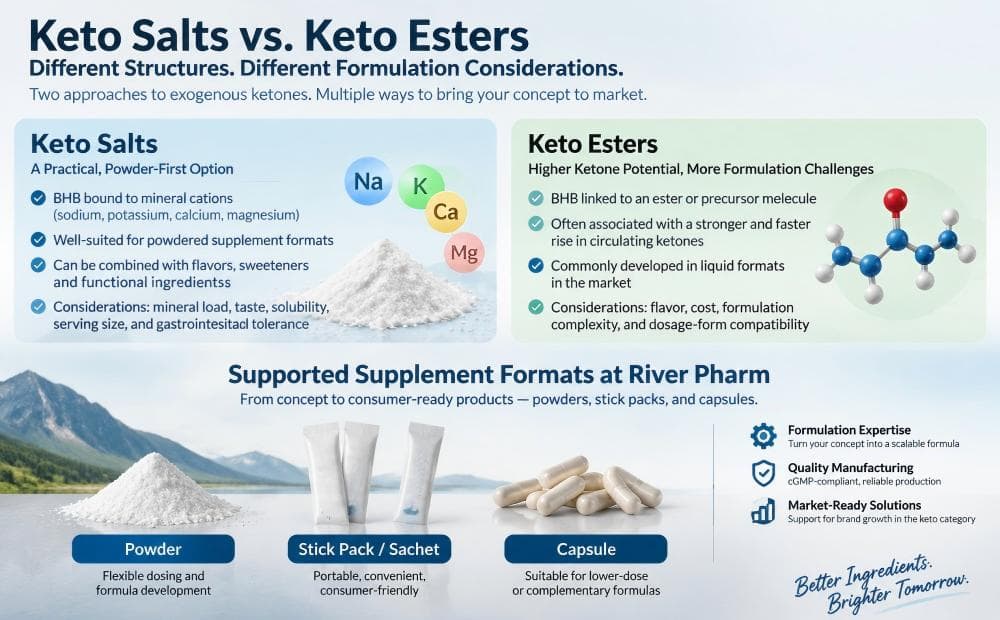
Keto Salts vs. Keto Esters: Formulation, Dose, Stability, and Manufacturing Considerations for Rapid Ketosis
Sep 24, 2026
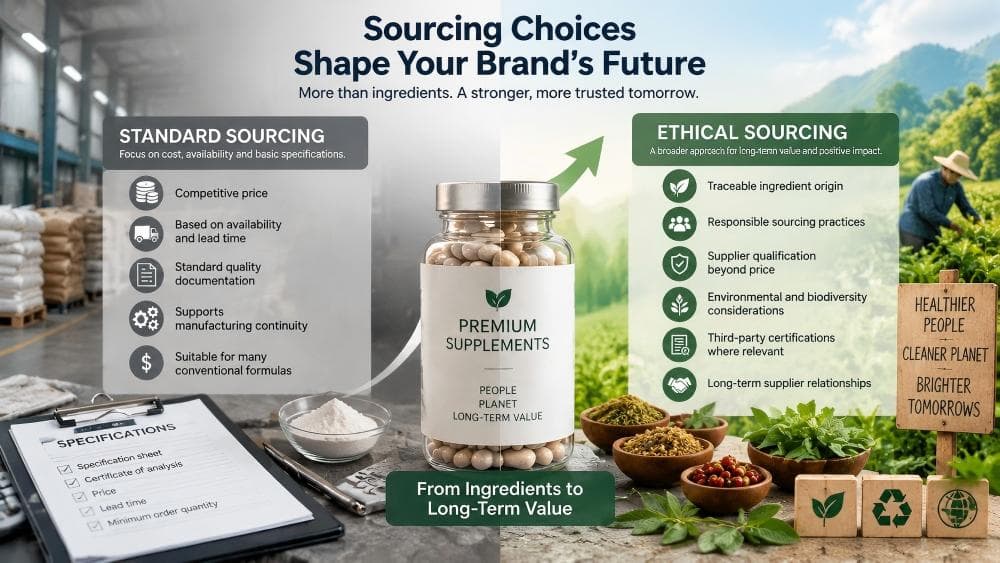
Standard Sourcing vs. Ethical Sourcing: The ROI of Sustainability in Premium Health Supplement Contracts
Riverpharm · Supplement Contract Manufacturing
Your supplement brand, manufactured to the highest standard
From first formula to finished product — we handle manufacturing, packaging, and fulfillment so you can focus on building your brand.
Core services
Contract Manufacturing
GMP-certified production with full batch testing and certificate of analysis on every run.
Custom Formulation & R&D
In-house scientists develop your formula from scratch or refine existing blends for efficacy.
Packaging & Labeling
Design-to-print label service — shelf-ready, FDA-compliant, and retail-tested.
FBA Prep & Fulfillment
Amazon-ready prep and direct-to-warehouse shipping — no extra steps on your end.
By the numbers
NSF
NSF/ANSI 455-2 certified
cGMP
Certified environment
24 hr
AI-accelerated quote turnaround
600K
cGMP+ encapsulator capacity per run
Why Riverpharm
Quality systems with higher standards
- NSF/ANSI 455-2 certified
- cGMP-certified environment
- In-house + third-party testing
- Source-locked ingredients
Production capacity with faster execution
- Heavy-duty hardware
- In-house core reserves
- AI-accelerated quotes
- In-house expert hub
Delivery formats we produce
Capsules
Gelatin & HPMC vegetarian
Sachets
Single-dose powder blends
Stick packs
Convenient single-serve
Pouches
Flexible, shelf-ready
Ready to bring your supplement to market?
Free consultation · 24-hour quote · No minimum commitment to get started