Keto Salts vs. Keto Esters: Formulation, Dose, Stability, and Manufacturing Considerations for Rapid Ketosis
Compare keto salts vs. keto esters for rapid ketosis, with expert guidance on dose, GI tolerance, powder formulation, stability, and manufacturing.
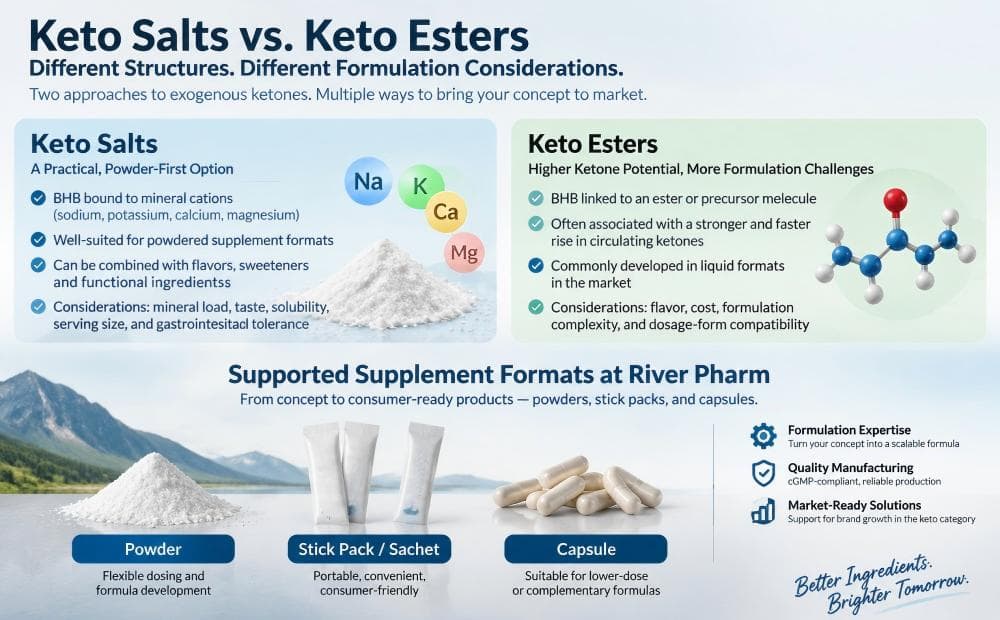
For a ketone supplement brand, the choice between keto salts vs. keto esters is not simply an ingredient-cost decision. It determines the achievable beta-hydroxybutyrate (BHB) dose, mineral load, flavor system, dosage form, packaging requirements, and the product experience consumers associate with "rapid ketosis."
At River Pharm Inc., we approach exogenous ketone development from a manufacturing perspective: first clarify the intended ketone-delivery profile, then select the ingredient system and dosage format that can reliably deliver it. For brands seeking powder sachets, stick packs, or capsule-based keto supplement formats, the formulation must balance BHB exposure with sensory acceptability, gastrointestinal tolerance, physical stability, and scalable production.
What Separates Keto Salts From Keto Esters?
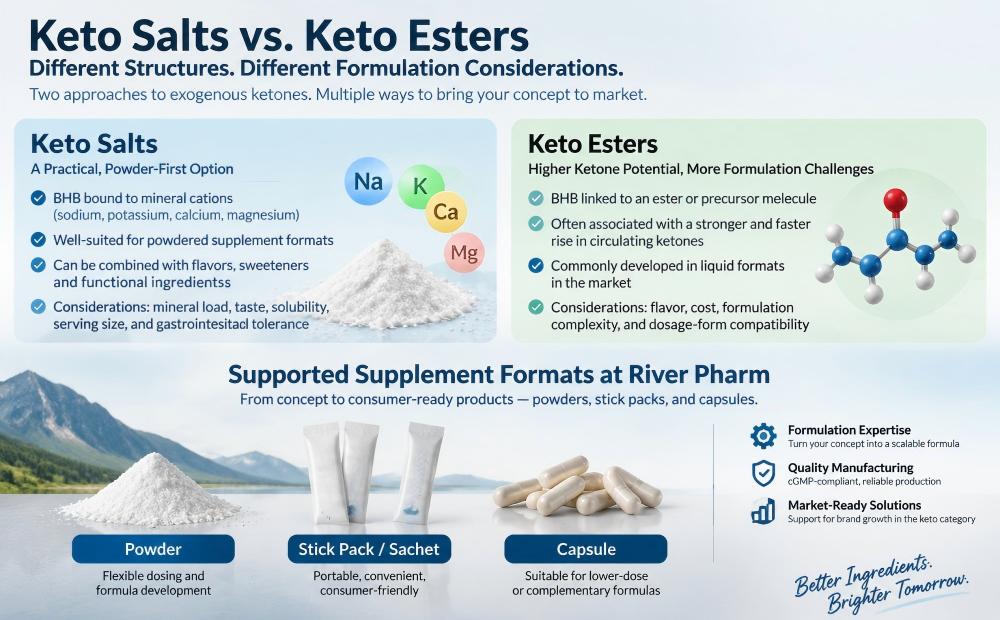
Exogenous ketones are generally formulated as ketone salts or ketone esters. Both categories aim to raise circulating ketone bodies—most commonly BHB—without requiring the consumer to fast or follow a strict ketogenic diet at the time of use. However, their chemical architecture and formulation constraints are very different.
Keto salts consist of BHB bound to mineral cations, commonly sodium, potassium, calcium, and magnesium. They are often selected for powdered drink mixes because they can be handled as dry ingredients and combined with flavors, acids, sweeteners, electrolytes, and functional co-ingredients.
Keto esters are BHB-related compounds linked to an ester or precursor molecule. A common research format is the ketone monoester, such as (R)-3-hydroxybutyl (R)-3-hydroxybutyrate. Ester systems are typically used when a brand prioritizes a stronger and faster rise in circulating ketones at a comparatively lower mineral burden.
The strategic distinction is straightforward:
- Keto salts are usually more compatible with familiar powdered beverage formats and electrolyte-positioned concepts.
- Keto esters are generally associated with brands targeting a higher ketone response, but they often involve more demanding flavor, cost, and formulation considerations, especially because many commercial keto ester products are developed in liquid formats.
- A salt-and-ester combination may be considered when a brand wants to balance ketone kinetics, acceptability, and dosage practicality, subject to ingredient availability, regulatory review, and stability validation.
Research literature consistently indicates that ketone monoesters can raise circulating R-BHB more strongly than ketone salts at comparable total ketone doses. In one cited comparison, a 24 g ketone monoester dose raised R-BHB to approximately 2.8 mM, while a ketone salt dose with a racemic R/S-BHB profile reached about 1.0 mM.
Keto Salts vs. Keto Esters for Brand Formulation
Keto Salts: A Powder-First Platform With Mineral Constraints
Keto salts are often the more practical starting point for a brand developing a keto powder supplement, particularly a single-serve stick pack or sachet. Their dry, blendable nature can support conventional powder-manufacturing workflows, including pre-blending, sieving, filling, and moisture-barrier packaging.
However, powder convenience does not automatically mean formulation simplicity.
A meaningful BHB dose from ketone salts can introduce a substantial mineral load. This affects more than the nutrition panel. It can influence:
- Taste, especially bitterness, salinity, chalkiness, and metallic notes.
- Solubility, particularly in cold water or low-volume serving conditions.
- Powder flow, where hygroscopic ingredients and mineral salts may increase caking risk.
- Serving size, because a high-dose system may require a large scoop or multiple stick packs.
- Gastrointestinal tolerance, especially when a concentrated drink delivers a high mineral and osmotic load quickly.
- Label strategy, because sodium, potassium, calcium, and magnesium declarations may become prominent.
For a powder product, it is essential to calculate the active BHB contribution separately from the total salt weight. A formula can look high-dose on paper while delivering less active BHB than the front-label concept implies. This is especially important when comparing R-BHB-only materials with racemic R/S-BHB materials, since the stereochemical form influences how researchers interpret blood ketone response data.
Keto Esters: Higher Ketone Potential, Higher Sensory Demands
Keto esters are typically selected when the commercial objective is a more pronounced or rapid rise in circulating ketones. A review in Experimental Physiology notes that ketone esters are generally more potent than ketone salts at elevating blood ketones and may produce fewer adverse effects related to gastrointestinal discomfort, although formulation, dose, and user conditions remain decisive.
The challenge is that keto esters can be difficult to make enjoyable.
Many ester systems present strong bitter, chemical, or lingering aftertaste notes. This creates a formulation paradox: a brand may choose an ester to pursue a higher-performance metabolic profile, then compromise the dose or add excessive flavoring in an effort to improve consumer acceptance.
For this reason, ester evaluation should begin with a practical product brief:
- What is the target BHB amount per serving?
- Is the selected ester system compatible with the intended supplement format and manufacturing pathway?
- Can the ingredient system achieve acceptable stability, sensory performance, and consumer usability within the selected dosage form?
- How much serving volume can the customer realistically consume?
- Is the brand willing to position the product around performance and efficacy rather than traditional beverage-like taste?
- Will the product be used fasted, around exercise, between meals, or as part of a daily metabolic routine?
A 2023 randomized crossover pilot study in 14 healthy young adults found that a 10 g ketone monoester dose produced a peak R-BHB concentration of 2.4 ± 0.1 mM at 15 minutes. A monoester/salt combination at the same total R-BHB dose reached a similar 2.1 ± 0.1 mM peak at 30 minutes.
This does not mean every commercial ester product will replicate those outcomes. Ingredient identity, isomer profile, dose, beverage matrix, fed versus fasted state, and consumer characteristics can all change ketone kinetics. Still, the data illustrate why brands often evaluate esters when "rapid ketosis" is central to their positioning.
Why Powdered Ketone Products Can Cause GI Complaints
"Powder" is not itself the cause of digestive discomfort. The real issue is the interaction between dose, mineral load, osmolality, dilution volume, sweetener system, and consumption speed.
A poorly designed keto salt powder may be difficult to tolerate because the consumer consumes a concentrated drink containing a high level of minerals and osmotic compounds in a short period. The issue becomes more likely when a product combines several high-load components, such as BHB mineral salts, magnesium, sodium, potassium, medium-chain triglyceride powder, fibers, caffeine, acids, and intense sweeteners.
Potential consumer-reported symptoms may include:
- Stomach discomfort.
- Nausea.
- Bloating.
- Belching.
- Loose stools.
- Heartburn.
- Headache.
- A feeling of excessive fullness or appetite suppression.
The available human research should be interpreted carefully. In the 2023 crossover trial, reported side effects were generally mild, and tolerability did not appear to differ materially between the tested ketone monoester and ketone monoester/salt drinks. The ester-only product, however, was more frequently associated with aftertaste, while appetite reduction was reported more often in the ester/salt condition.
The practical takeaway for a brand is not that one format guarantees better tolerance. It is that tolerance must be engineered, tested, and communicated responsibly.
How to Formulate for Rapid Ketosis With Better Tolerance
A stronger formula is not always a better formula. The most commercially durable product is often the one that delivers a clear, repeatable experience without forcing consumers to choose between efficacy and digestive comfort.
1. Define a Realistic Ketone Target
Start with the desired use case rather than copying a competitor's front-label number.
For example:
- An entry-level daily powder may prioritize moderate BHB delivery, improved flavor, and repeat purchase.
- A sports-oriented ketone concept may prioritize faster ketone elevation and convenient serving formats that match the selected manufacturing capability.
- A premium metabolic-support product may explore an ester or ester-plus-salt direction, subject to ingredient feasibility, dosage-form compatibility, and formulation review.
- A capsule concept may support lower-dose positioning or complementary ingredients but is usually not the most efficient route for high-BHB delivery because of capsule fill-volume limitations.
The research base includes many acute-dose studies using approximately 10–50 g of exogenous ketones, but those research doses may not always translate directly into a viable consumer product. Ingredient cost, sensory limitations, serving mass, and intended frequency of use all matter.
2. Control Mineral Load Before Adding More Actives
For keto salt formulas, mineral calculations should be made early—not after flavor development begins.
The formulation team should evaluate:
- Total sodium per serving.
- Total potassium per serving.
- Total calcium and magnesium contribution.
- The ratio of different BHB salts.
- Total active BHB versus total mineral-salt mass.
- The effect of other electrolyte ingredients already included in the formula.
- Intended serving frequency per day.
This step protects both product quality and label clarity. A high-BHB salt formula may need to be simplified rather than continuously "improved" with additional electrolyte ingredients.
3. Design the Drink Matrix, Not Just the Ingredient List
The same ketone ingredient can perform very differently depending on the delivery matrix.
For powder sachets and stick packs, key development variables include:
- Water solubility and suspension behavior.
- Reconstitution time in cold water.
- Recommended dilution volume on the label.
- Acid system compatibility, including citric, malic, or other food acids.
- Sweetener profile, which should reduce bitterness without creating an excessively lingering finish.
- Flavor architecture, often requiring top notes, body notes, and bitterness-masking components.
- Anti-caking strategy and moisture protection.
- Serving instructions, including whether the drink should be sipped rather than consumed rapidly.
For powder-based keto supplements, development priorities focus on ingredient compatibility, moisture protection, flavor stability, solubility, powder flow, and consistent manufacturing performance.
4. Use Sensory Testing Before Finalizing the Dose
A formula that looks efficient in a spreadsheet may fail at first use because of bitterness, aroma, excessive salinity, or an unpleasant finish.
A practical pilot process should include:
1. Screen several flavor directions at the same active dose.
2. Compare different sweetener and acid systems.
3. Evaluate the product both immediately after mixing and after standing.
4. Record perceived bitterness, saltiness, mouthfeel, aftertaste, and ease of consumption.
5. Conduct tolerance screening with appropriate safeguards and compliant product-evaluation procedures.
6. Reassess the formula after accelerated and real-time stability testing.
An expert development team should also avoid masking a high active load with excessive stimulants, laxative-type ingredients, or overcomplicated "keto blend" claims. Simpler formulas are often easier to manufacture consistently and easier for consumers to understand.

Format Selection: Powder, Stick Pack, or Capsule?
River Pharm Inc. supports multiple supplement formats, but each one creates a different formulation pathway.
Powder Jars and Sachets
Powders are appropriate when the brand wants an accessible daily-use format and flexible serving size. They work especially well for keto salt systems, electrolyte-oriented formulas, and flavored BHB drink concepts.
Key considerations include moisture protection, scoop or sachet dose accuracy, flowability, reconstitution, and sensory performance.
Stick Packs and Strip Packs
Single-serve sticks are a strong fit for travel, gyms, office use, and controlled per-serving dosing. They can support a premium convenience position, but the available fill weight is limited. High-load keto salt formulas may require larger sticks, multiple sticks per serving, or a revised active-dose target.
Capsules
Capsules are useful for complementary keto-support ingredients, but they are not usually the first choice for a meaningful standalone BHB dose. The amount of material needed can result in too many capsules per serving. Capsule formats should be selected for user convenience only when the dose requirement is compatible with realistic capsule counts.
Selecting the Right Supplement Format
Powder sachets, stick packs, and capsules each provide different advantages depending on the target dose, consumer usage scenario, ingredient characteristics, and manufacturing requirements.
Powder formats are often suitable for keto salt systems because they support dry blending, flexible serving sizes, and convenient storage. Stick packs provide portability and controlled dosing, while capsules may be considered for lower-dose concepts or complementary keto-support formulas.

Manufacturing Controls That Protect Product Consistency
A successful keto product is not only about selecting keto salts or keto esters. It must also be manufactured under a documented quality system with clear specifications from raw material receipt through finished-product release.
For dietary supplements marketed in the United States, current good manufacturing practice requirements under 21 CFR Part 111 apply to the manufacturing, packaging, labeling, and holding of dietary supplements. These requirements emphasize specifications, quality control, recordkeeping, and appropriate manufacturing controls.
For a ketone formula, the manufacturing file should define:
- Raw-material identity and specification requirements.
- BHB form and enantiomeric composition where relevant.
- Active ingredient assay targets.
- Heavy metals, microbial, and other contaminant specifications as appropriate.
- Blend uniformity requirements for powders.
- Fill-weight controls for sachets, stick packs, and capsules.
- Moisture specifications and packaging-barrier requirements.
- Organoleptic standards for color, odor, taste, and appearance.
- Stability protocol and shelf-life acceptance criteria.
- Finished-product release criteria and retain-sample procedures.
For brands, this documentation is not administrative overhead. It is the foundation for consistent production, clearer supplier communication, and reliable scale-up from pilot batches to commercial orders.
A Better Decision Framework for Brands
Choose keto salts when your product concept requires a powder-first format, electrolyte compatibility, moderate cost positioning, and broad daily-use appeal. Be prepared to manage mineral load, taste, solubility, and serving-size limitations.
Choose keto esters when your concept centers on higher ketone exposure and faster ketone kinetics. However, ester selection requires careful evaluation of ingredient characteristics, sensory challenges, dosage-form compatibility, and manufacturing feasibility. Be prepared to invest more heavily in taste masking, format selection, dose validation, and stability work.
Consider a custom combination approach when the brand has a clear reason to balance immediate BHB delivery, sensory performance, mineral exposure, and target serving format. This should be a research-led formulation decision, not a generic private-label shortcut.
The research remains developing. While human studies show that exogenous ketones can raise circulating ketones and may affect glucose metabolism, many longer-term outcomes, repeated-use protocols, and population-specific effects still require further study. Product claims should therefore remain specific, substantiated, and appropriate to the target market.
Develop Your Custom Keto Supplement With River Pharm
River Pharm Inc. provides OEM manufacturing for brands that already have an established formula, and custom ODM development for brands that provide a reference product, ingredient direction, or intended benefit profile.
If your brand is evaluating keto salts, keto esters, or a customized exogenous ketone system, our team can help assess:
- Active-form and dose feasibility.
- Powder, sachet, stick pack, or capsule suitability.
- Flavor and sensory-development direction.
- Mineral-load and serving-size constraints.
- Packaging and stability requirements.
- Scalable manufacturing specifications.
Share your target market, reference concept, preferred format, and desired ingredient direction with River Pharm to begin a custom keto supplement feasibility review.
FAQ
1. Are keto salts or keto esters better for rapid ketosis?
Keto esters generally show greater potential to raise circulating ketones more quickly and to a higher level than keto salts at comparable doses. However, the final result depends on the exact ingredient, stereochemical profile, serving dose, food matrix, and whether the product is used fasted or fed.
2. Why do keto salt powders sometimes cause stomach discomfort?
The issue can result from high mineral load, concentrated mixing, rapid consumption, high osmolality, sweetener selection, or the addition of other high-load ingredients. A carefully balanced formula, adequate dilution guidance, and realistic per-serving dosing can help reduce the risk of an unpleasant consumer experience.
3. Can keto esters be made as a powder supplement?
It depends on the specific ester system and formulation technology. Many commercial ester concepts are developed in liquid formats, but each ester ingredient requires evaluation for stability, sensory performance, and compatibility with the intended manufacturing pathway. A feasibility assessment should determine whether a dry format can protect ingredient stability and provide an acceptable taste and practical serving size.
4. Are capsules suitable for a high-dose ketone supplement?
Usually, capsules are less suitable for high-dose BHB delivery because the ingredient quantity may require an impractical number of capsules per serving. Capsules can work better for lower-dose concepts or for complementary ingredients within a broader keto-support product.
5. Can a formula combine keto salts and keto esters?
A combined system may be technically possible depending on the selected ingredients, intended dosage format, regulatory pathway, sensory requirements, and stability results. It should be developed as a custom formulation with clear objectives rather than as a standard label-copying exercise.
6. What information should a brand provide before developing a custom keto product?
Provide the target country or countries, desired dosage format, reference product if available, intended consumer group, desired active ingredients, target serving size, preferred flavor direction, and any label or certification requirements. This information helps determine whether a salt, ester, or hybrid concept is the best manufacturing route.
References
1. Bolyard, M. L., Graziano, C. M., Fontaine, K. R., Sayer, R. D., Fisher, G., & Plaisance, E. P. "Tolerability and Acceptability of an Exogenous Ketone Monoester and Ketone Monoester/Salt Formulation in Humans." Nutrients, 2023, 15(23), 4876. Available at: [PubMed Central]. [pmc.ncbi.nlm.nih]
2. Falkenhain, K., Islam, H., & Little, J. P. "Exogenous Ketone Supplementation: An Emerging Tool for Physiologists With Potential as a Metabolic Therapy." Experimental Physiology, 2023, 108(2), 177–187. Available at: [PubMed Central]. [pmc.ncbi.nlm.nih]
3. Myette-Côté, É., et al. "Prior Ingestion of Exogenous Ketone Monoester Attenuates the Glycemic Response to an Oral Glucose Tolerance Test in Healthy Young Individuals." American Journal of Clinical Nutrition, 2018. Available through the [University of Oxford Research Archive]. [ora.ox.ac]
4. U.S. Food and Drug Administration. "Dietary Supplement Current Good Manufacturing Practices." Regulatory framework covering requirements for dietary-supplement manufacturing, packaging, labeling, and holding under 21 CFR Part 111. See the [FDA dietary supplement information portal].
5. NutraIngredients. "The Rise of Exogenous Ketones for Athletic Recovery." Industry reporting on the expanding exogenous ketone category and the role of BHB mineral-salt systems. Available at [NutraIngredients]. [nutraingredients]
6. U.S. Code of Federal Regulations. "21 CFR Part 111—Current Good Manufacturing Practice in Manufacturing, Packaging, Labeling, or Holding Operations for Dietary Supplements." Available through the [Electronic Code of Federal Regulations].
Hot Tags: Keto Supplement Manufacturer, Exogenous Ketone Powder, Keto Salt Formulation, Ketone Ester Manufacturing, Custom Keto Supplements, Dietary Supplement OEM, Dietary Supplement ODM, BHB Powder Manufacturer, Stick Pack Supplement Manufacturing, custom, private label, manufacturing company, manufacturers, suppliers, factory, Customized, Bulk, quotation, oem
Did you find this helpful?
Comments (0)
No comments yet. Be the first to comment!
Leave a comment
Related Posts

Oct 14, 2026
Why Full-Service Supplement Manufacturing Matters for Growing Brands

Oct 13, 2026
Batch Consistency vs. Rapid Prototyping: Solving the Scaling Issues in Custom Supplement Formulation
Sep 24, 2026
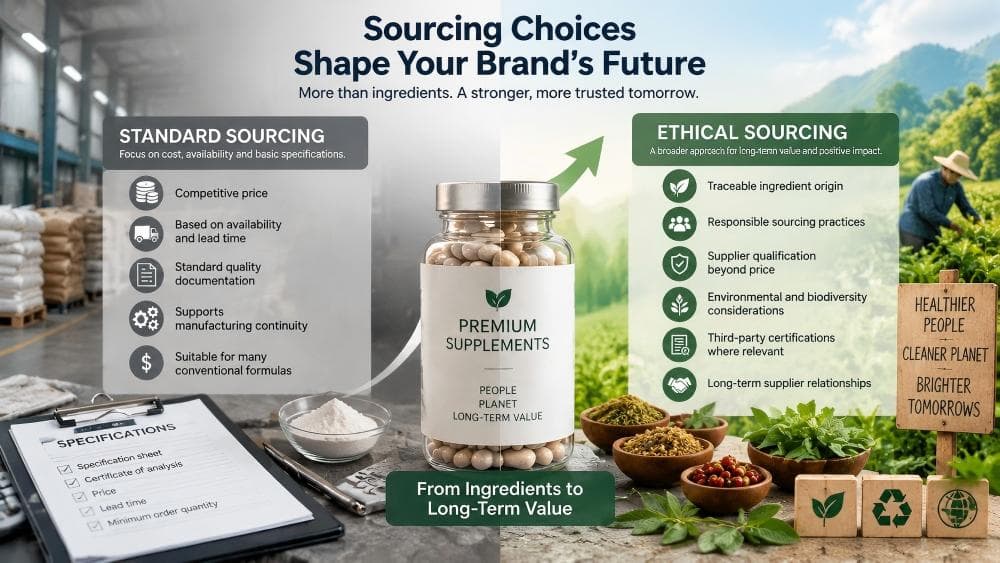
Standard Sourcing vs. Ethical Sourcing: The ROI of Sustainability in Premium Health Supplement Contracts
Riverpharm · Supplement Contract Manufacturing
Your supplement brand, manufactured to the highest standard
From first formula to finished product — we handle manufacturing, packaging, and fulfillment so you can focus on building your brand.
Core services
Contract Manufacturing
GMP-certified production with full batch testing and certificate of analysis on every run.
Custom Formulation & R&D
In-house scientists develop your formula from scratch or refine existing blends for efficacy.
Packaging & Labeling
Design-to-print label service — shelf-ready, FDA-compliant, and retail-tested.
FBA Prep & Fulfillment
Amazon-ready prep and direct-to-warehouse shipping — no extra steps on your end.
By the numbers
NSF
NSF/ANSI 455-2 certified
cGMP
Certified environment
24 hr
AI-accelerated quote turnaround
600K
cGMP+ encapsulator capacity per run
Why Riverpharm
Quality systems with higher standards
- NSF/ANSI 455-2 certified
- cGMP-certified environment
- In-house + third-party testing
- Source-locked ingredients
Production capacity with faster execution
- Heavy-duty hardware
- In-house core reserves
- AI-accelerated quotes
- In-house expert hub
Delivery formats we produce
Capsules
Gelatin & HPMC vegetarian
Sachets
Single-dose powder blends
Stick packs
Convenient single-serve
Pouches
Flexible, shelf-ready
Ready to bring your supplement to market?
Free consultation · 24-hour quote · No minimum commitment to get started