Standard Sourcing vs. Ethical Sourcing: The ROI of Sustainability in Premium Health Supplement Contracts
Compare standard and ethical sourcing for premium supplements and learn how responsible sourcing can strengthen quality, trust, and long-term ROI.
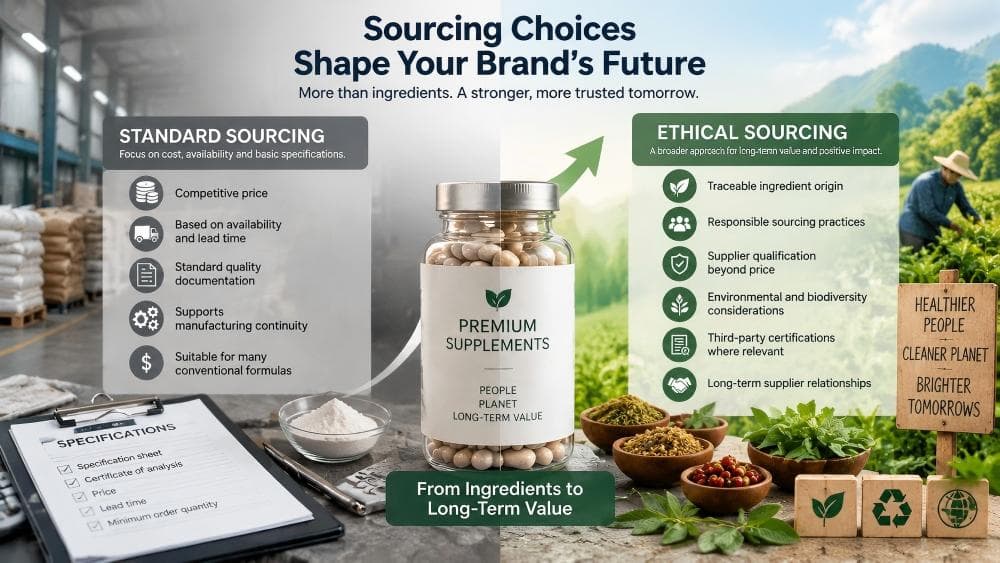
For premium health supplement brands, sourcing is no longer a back-office purchasing decision. The difference between standard sourcing and ethical sourcing can affect ingredient consistency, manufacturing continuity, product-positioning credibility, customer trust, and the long-term return on investment of a supplement contract.
At River Pharm Inc., we work with brands that need more than basic production capacity. Whether a client provides a finished formula for OEM manufacturing or brings a reference product, ingredient concept, or desired wellness direction for custom ODM development, the sourcing strategy established before production can shape the entire commercial outcome. For capsules, sachets, stick packs, and soft pouch formats, responsible material selection and supplier verification help create products that are easier to document, easier to defend, and more resilient in demanding international markets.
Standard sourcing may appear cheaper at the quotation stage. Ethical sourcing can require more supplier due diligence, documentation, testing, and coordination. However, for premium supplement contracts, the most relevant question is not simply, "What is the lowest ingredient price?" It is: Which sourcing model creates the strongest total value over the life of the product?
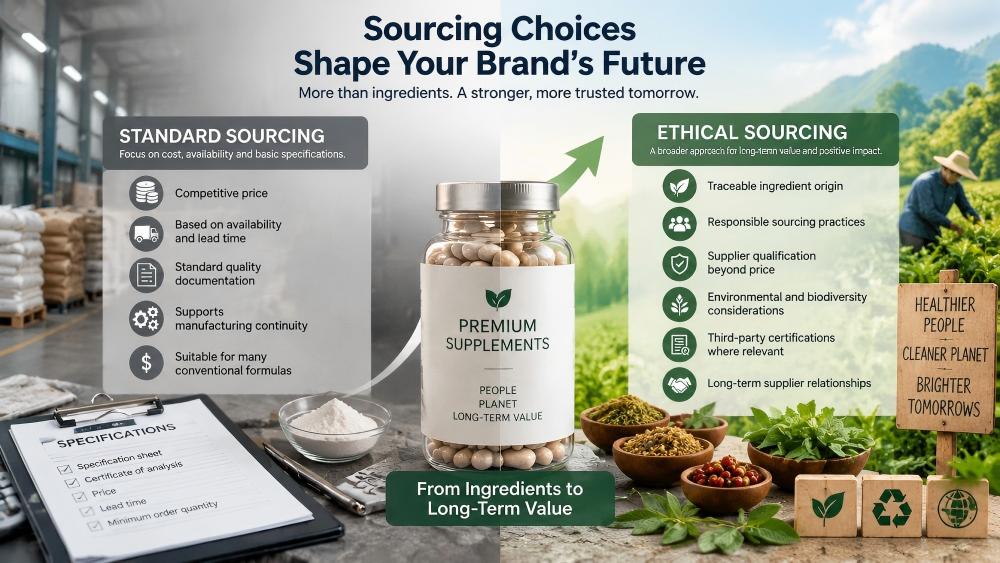
What Standard Sourcing Means in Supplement Manufacturing
Standard sourcing generally focuses on obtaining ingredients that meet agreed commercial specifications at a competitive price and within the required production timeline.
In practice, this approach may include:
- Comparing multiple approved suppliers for cost and lead time
- Purchasing ingredients based on specification sheets and certificates of analysis
- Selecting materials according to availability, minimum order quantity, and commercial terms
- Using standard quality documentation to support incoming-material review
- Prioritizing manufacturing continuity and target cost
Standard sourcing is not automatically poor sourcing. A well-managed conventional sourcing program can be suitable for many dietary supplement projects, particularly when the formula uses established vitamins, minerals, amino acids, or common excipients with stable global availability.
For example, a brand launching a straightforward vitamin D3 capsule may prioritize a consistent active ingredient specification, packaging compatibility, shelf-life requirements, and batch-level documentation. If the product does not rely on a vulnerable agricultural supply chain, a highly specialized ethical sourcing program may not be the primary factor driving purchase decisions.
However, standard sourcing has limitations when a brand is developing a premium product, using botanicals, highlighting natural origin, targeting sustainability-conscious consumers, or selling into markets where buyers increasingly ask for supply-chain transparency.
A certificate of analysis is important, but it is not the full sourcing story. It may confirm certain specifications for a specific lot, yet it does not automatically demonstrate how the botanical was cultivated, how workers were treated, how biodiversity risks were addressed, whether the supply route is stable, or whether the supplier can provide meaningful traceability beyond the immediate transaction.
What Ethical Sourcing Means for Premium Supplements
Ethical sourcing is a broader procurement framework. It considers not only whether an ingredient can meet identity, purity, strength, and composition requirements, but also whether the supply chain is managed responsibly from an environmental, social, and governance perspective.
For a dietary supplement brand, ethical sourcing may involve:
- Documented ingredient origin and supply-chain traceability
- Responsible agricultural and harvesting practices
- Supplier qualification beyond price and basic availability
- Attention to labor practices and community impact
- Biodiversity and conservation considerations for botanicals
- Sustainable farming, wild-harvesting, or marine-resource management
- Clear change-control procedures if an ingredient source changes
- Third-party certifications or verification where relevant
- Packaging-material decisions that support the brand's environmental goals
- Long-term supplier relationships rather than frequent spot buying
The key distinction is simple: standard sourcing asks whether the ingredient can be purchased and used; ethical sourcing asks whether the ingredient can be purchased, used, documented, and responsibly defended.
This distinction is particularly important for ingredients such as herbal extracts, mushrooms, marine collagen, plant oils, probiotics, specialty fibers, fruit powders, and other materials with geographically concentrated or agriculturally sensitive supply chains.
NutraIngredients has reported that traceability can support both scientific confidence and sustainability goals, because deeper supplier knowledge helps brands understand how ingredients are produced and sourced. The publication also notes that brands increasingly expect transparency, data sharing, and supply-chain visibility from ingredient partners.
Standard vs. Ethical Sourcing: Key Differences
FDA requirements remain central to dietary supplement manufacturing. Under the dietary supplement current good manufacturing practice rule, manufacturers must conduct at least one appropriate test or examination to verify the identity of each dietary ingredient before use, unless an approved exemption applies. Manufacturers also must establish specifications and determine whether component specifications are met through appropriate testing, examination, or justified reliance on supplier certificates of analysis.
In other words, responsible sourcing cannot be used as a marketing substitute for quality verification. A sustainably positioned botanical still needs identity confirmation, specification control, and appropriate testing.
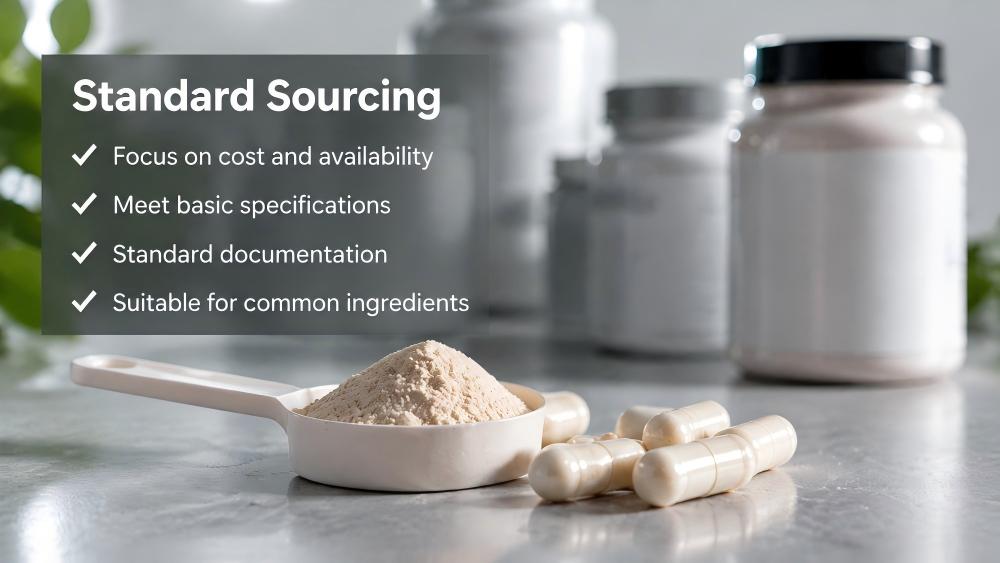
Why Ethical Sourcing Can Deliver Higher ROI
The return on investment from ethical sourcing rarely appears as one direct line item. It is more often visible through avoided costs, commercial differentiation, reduced disruptions, and improved customer confidence.
1. Lower Risk of Expensive Ingredient Problems
A low-cost ingredient becomes expensive when it creates delays, failed testing, reformulation work, inconsistent sensory performance, documentation gaps, or customer complaints.
A stronger sourcing framework can reduce the likelihood of:
- Material substitution or identity concerns
- Inconsistent active-marker levels in botanical extracts
- Heavy metal, microbial, pesticide, or adulteration risks
- Late-stage formulation changes
- Packaging or labeling delays caused by incomplete documentation
- Supply interruptions resulting from unqualified alternative vendors
- Quality disputes between a brand and contract manufacturer
The U.S. Food and Drug Administration explains that dietary supplement manufacturing requirements are designed to help ensure the identity, purity, strength, and composition of supplements. These controls help reduce the risk of wrong ingredients, incorrect amounts, contamination, and improper packaging or labeling.
For a premium brand, prevention has a practical financial value. Rejected raw materials, delayed launches, emergency air freight, redesign work, and unsellable packaging can quickly exceed the apparent savings from selecting the lowest-priced ingredient supplier.
2. Better Supply Continuity for Specialized Ingredients
Supply-chain instability is a major hidden cost in supplement development. Weather events, crop variability, geopolitical disruption, harvest restrictions, changing import requirements, and demand spikes can all affect ingredient availability.
Ethical sourcing often encourages brands and manufacturers to build longer-term relationships with suppliers, understand source regions, define acceptable alternatives in advance, and create change-control procedures before a shortage occurs.
This matters especially for plant-based ingredients. A botanical extract is not just a commodity. Its quality can be influenced by species identity, plant part used, harvest timing, extraction method, carrier system, standardization method, and storage conditions.
A robust sourcing plan should answer questions such as:
- Is the botanical cultivated, wild harvested, or blended from multiple origins?
- What is the scientific identity of the plant material?
- Which part of the plant is used?
- How is the extract standardized?
- What happens if the original source becomes unavailable?
- Can the supplier provide comparable documentation for an alternative source?
- Will a change affect color, flavor, flowability, solubility, or active-marker content?
When these questions are addressed early, brands are less likely to face unexpected reformulation after packaging artwork, commercial forecasting, and launch campaigns are already underway.
3. Stronger Premium Brand Positioning
Premium supplement buyers increasingly assess products through a broader trust lens. They may want evidence of quality, transparent ingredient selection, clinically relevant dosages, cleaner labels, responsible packaging, and supply-chain accountability.
Ethical sourcing can support a more credible product narrative when the supporting evidence exists. It can help a brand explain why it selected a specific botanical source, marine ingredient, plant oil, or specialty nutrient rather than relying on generic claims.
For example, a brand launching a botanical sleep-support stick pack could move beyond vague language such as "premium herbal blend." If documentation supports it, the brand may instead communicate a more meaningful story around standardized botanical quality, responsible harvesting practices, traceability, and careful manufacturing controls.
The value is not in making broad environmental claims. The value is in making specific, supportable, and relevant statements that reflect the actual supply chain.
4. Higher Value in B2B Retail and Distribution Discussions
Retailers, distributors, practitioners, and procurement teams may request product documentation before accepting a new supplement line. The more premium the commercial channel, the more likely a brand will encounter questions about manufacturing controls, ingredient origin, quality testing, certifications, and supply-chain practices.
Ethical sourcing can improve readiness for those conversations by giving the brand a more organized evidence package.
A useful premium-supplement sourcing file may include:
- Ingredient specification sheet
- Certificate of analysis requirements
- Supplier qualification records
- Country-of-origin information where available
- Allergen and contaminant statements
- Botanical identity documentation
- Sustainability or ethical certification records, if applicable
- Change-notification expectations
- Packaging-material specifications
- Product batch and traceability records
This documentation does not guarantee a retail listing. However, it reduces the friction involved in answering procurement questions and demonstrates that the brand has considered its responsibilities beyond label design.
Ethical Sourcing Is Not a Universal "Green Premium"
A common mistake is treating ethical sourcing as an automatic price increase with no commercial discipline. That approach can weaken margins without improving trust.
The right question is not, "Should every ingredient carry every certification?" The better question is, "Which sourcing investments are material to our product, customer, claim strategy, and risk profile?"
For some ingredients, full origin traceability and specialized certification may be commercially essential. For others, rigorous identity testing, reliable supplier qualification, and complete quality documentation may create more value than adding an unrelated sustainability label.
Brands should avoid three common problems:
- Using broad sustainability language without evidence
- Paying for certifications that do not matter to the target customer
- Treating ethical sourcing as separate from quality and regulatory planning
Ethical sourcing works best when it is integrated into formulation, packaging, claims, and contract manufacturing decisions from the beginning.
A Practical Sourcing Framework for Brands
Before requesting an OEM quotation or custom ODM development proposal, brands should define their sourcing priorities in writing.
Step 1: Identify Product-Critical Ingredients
Not every ingredient has the same sourcing risk.
Classify ingredients by:
- Consumer visibility
- Supply volatility
- Contamination or adulteration risk
- Agricultural or biodiversity impact
- Need for origin storytelling
- Regulatory sensitivity
- Impact on taste, texture, color, or stability
- Contribution to product claims and differentiation
For a simple mineral capsule, the critical material may be the active ingredient's chemical form and assay. For a botanical sachet, the critical materials may include species verification, extract ratio, active-marker range, harvest origin, and contaminant profile.
Step 2: Define Evidence Before Production
Brands should decide what evidence is needed before sampling, scale-up, and packaging procurement.
This may include:
- Target specifications for active ingredients
- Acceptable test methods
- Required certificates and declarations
- Preferred country or region of origin
- Prohibited sourcing practices
- Required supplier-change notification process
- Acceptable packaging materials
- Documentation needed for market-facing communications
The NIH Office of Dietary Supplements provides evidence-based information on dietary supplements, including ingredient safety, recommended amounts, interactions, and other health-related considerations. These resources can help brands distinguish ingredient education from unsupported product claims during early concept development.
Step 3: Build Change Control into the Contract
Ingredient changes should not be treated as routine purchasing substitutions.
A premium supplement contract should clarify:
- Whether substitutions require brand approval
- Which ingredient characteristics cannot change
- What documentation is required for proposed alternatives
- Whether a new sample or stability review is needed
- How packaging, claims, and regulatory implications will be assessed
- How the manufacturer will communicate supply interruptions
This is especially important for custom ODM projects. When River Pharm develops a formula from a client's benchmark product, target ingredient profile, or desired function, sourcing decisions can affect formulation feasibility, sensory experience, dosage form, and commercial positioning.
Step 4: Measure ROI Beyond Cost per Kilogram
A practical sourcing ROI review should include both direct and indirect costs.
Consider:
- Ingredient cost
- Testing and documentation cost
- Lead time and inventory risk
- Probability of rejected lots
- Cost of reformulation
- Risk of delayed launch
- Brand value created by traceable sourcing
- Retailer or distributor documentation requirements
- Customer retention and repeat purchase potential
- Cost of reputational damage if sourcing claims cannot be substantiated
The lowest material quote is not always the lowest total cost.
How River Pharm Supports Responsible Supplement Development
River Pharm Inc. provides manufacturing support for brands developing capsules, sachets, stick packs, and soft pouch products.
Our OEM model is straightforward: you provide the formula, and we manufacture it. For custom ODM projects, you can provide a reference product, target ingredients, or a desired wellness direction, and our team can support research, formulation development, and manufacturing. We do not offer public-mold private-label ODM programs.
For brands that want to build a more responsible sourcing strategy into their product development, the most productive starting point is a detailed project brief. This allows the formulation, quality, procurement, and packaging discussions to happen together rather than in isolated stages.
A strong project brief should include:
- Target market and intended customer
- Product format: capsule, sachet, stick pack, or soft pouch
- Formula or reference product
- Desired ingredients and dosage range
- Ingredient restrictions or preferred sourcing criteria
- Target price range and order volume
- Packaging requirements
- Documentation expectations
- Planned product claims and positioning
- Desired launch timeline
This approach helps identify potential sourcing trade-offs before they become expensive production issues.

Final Takeaway
Standard sourcing can be appropriate when ingredient risk is low, specifications are stable, and the product competes primarily on cost and availability. Ethical sourcing becomes more valuable when a premium supplement brand needs traceability, responsible ingredient narratives, stronger risk management, and a supply chain that supports long-term commercial trust.
The return on ethical sourcing is not limited to a sustainability message. It can appear through fewer disruptions, stronger documentation, more credible positioning, better partner conversations, and a product story that customers can understand and believe.
Ready to develop a premium supplement with sourcing requirements built into the process? Share your formula, benchmark product, target ingredients, preferred format, and market objectives with River Pharm. Our team can evaluate manufacturing feasibility and help you move from concept to scalable OEM or custom ODM production.
FAQ
1. What is the difference between standard sourcing and ethical sourcing for supplements?
Standard sourcing focuses primarily on specification compliance, price, availability, and lead time. Ethical sourcing also considers traceability, environmental impact, labor practices, supplier transparency, biodiversity concerns, and long-term supply-chain resilience.
2. Does ethical sourcing replace raw-material testing?
No. Ethical sourcing does not replace quality control. Dietary supplement manufacturers still need appropriate processes to verify ingredient identity and confirm that component specifications are met. FDA dietary supplement manufacturing requirements specifically address identity, purity, strength, and composition controls.
3. Is ethical sourcing only relevant to botanical supplements?
No. It can apply to vitamins, minerals, probiotics, marine ingredients, collagen, oils, packaging materials, and specialty nutrients. However, it is often especially important for botanicals and agricultural materials because origin, harvest conditions, biodiversity, and contamination risk can have a major effect on supply and product quality.
4. Can ethical sourcing increase the cost of a supplement contract?
It can increase upfront costs because it may require supplier assessments, expanded documentation, traceability work, testing, certifications, or longer-term procurement planning. However, it may also reduce the larger costs associated with rejected materials, supply disruption, reformulation, delayed launches, and weak brand credibility.
5. What sourcing documents should a premium supplement brand request?
Common documents include specifications, certificates of analysis, ingredient origin information where available, allergen statements, contaminant testing information, supplier qualification evidence, botanical identity records, and change-control procedures. The exact documentation should match the ingredient risk, target market, and planned product claims.
6. Can River Pharm help with custom formulas based on a competitor or reference product?
Yes. For custom ODM development, River Pharm can work from a reference product, target ingredients, or desired wellness direction to research, formulate, and manufacture a differentiated supplement. The service is not a public-mold private-label program.
7. Which formats can River Pharm manufacture?
River Pharm supports supplement manufacturing for capsules, sachets, stick packs, and soft pouch packaging. The best format depends on dosage, ingredient stability, sensory requirements, serving size, target customer, and packaging objectives.
References
1. U.S. Food and Drug Administration. "Small Entity Compliance Guide: Current Good Manufacturing Practice in Manufacturing, Packaging, Labeling, or Holding Operations for Dietary Supplements." Covers manufacturer obligations under 21 CFR Part 111, including dietary-ingredient identity verification and component specifications. [FDA source]. [fda]
2. U.S. Food and Drug Administration. "Final Rule for Current Good Manufacturing Practices for Dietary Supplements." Explains the role of manufacturing controls in assuring supplement identity, purity, quality, strength, and composition. [FDA source]. [fda]
3. National Institutes of Health, Office of Dietary Supplements. "Dietary Supplements: What You Need to Know." Provides consumer-focused guidance on dietary supplement quality, safety, labeling, and manufacturing standards. [NIH ODS source]. [ods.od.nih]
4. National Institutes of Health, Office of Dietary Supplements. "Health Information." Provides evidence-based ingredient resources, including information on safety, recommended amounts, interactions, and supplement quality. [NIH ODS source]. [ods.od.nih]
5. NutraIngredients. "Ritual CEO on What Will Define Beauty-From-Within in 2026." Discusses the relationship between ingredient traceability, scientific confidence, supplier transparency, and sustainability expectations. [NutraIngredients source]. [nutraingredients]
6. NutraIngredients. "Verdure Sciences Awarded Certification for Sustainable and Ethical Sourcing." Discusses standards focused on ethical and respectful sourcing of botanical ingredients, biodiversity, and sourcing communities. [NutraIngredients source]. [nutraingredients]
Hot Tags: Dietary Supplement Manufacturing, Supplement Contract Manufacturing, Ethical Sourcing, Sustainable Ingredient Sourcing, Supplement OEM Manufacturing, Custom Supplement ODM, Nutraceutical Manufacturing, Raw Material Traceability, Dietary Supplement Supply Chain, Premium Supplement Brands, custom, private label, manufacturing company, manufacturers, suppliers, factory, Customized, Bulk, quotation, oem
Did you find this helpful?
Comments (0)
No comments yet. Be the first to comment!
Leave a comment
Related Posts



Riverpharm · Supplement Contract Manufacturing
Your supplement brand, manufactured to the highest standard
From first formula to finished product — we handle manufacturing, packaging, and fulfillment so you can focus on building your brand.
Core services
Contract Manufacturing
GMP-certified production with full batch testing and certificate of analysis on every run.
Custom Formulation & R&D
In-house scientists develop your formula from scratch or refine existing blends for efficacy.
Packaging & Labeling
Design-to-print label service — shelf-ready, FDA-compliant, and retail-tested.
FBA Prep & Fulfillment
Amazon-ready prep and direct-to-warehouse shipping — no extra steps on your end.
By the numbers
NSF
NSF/ANSI 455-2 certified
cGMP
Certified environment
24 hr
AI-accelerated quote turnaround
600K
cGMP+ encapsulator capacity per run
Why Riverpharm
Quality systems with higher standards
- NSF/ANSI 455-2 certified
- cGMP-certified environment
- In-house + third-party testing
- Source-locked ingredients
Production capacity with faster execution
- Heavy-duty hardware
- In-house core reserves
- AI-accelerated quotes
- In-house expert hub
Delivery formats we produce
Capsules
Gelatin & HPMC vegetarian
Sachets
Single-dose powder blends
Stick packs
Convenient single-serve
Pouches
Flexible, shelf-ready
Ready to bring your supplement to market?
Free consultation · 24-hour quote · No minimum commitment to get started