Carbohydrate Powder Benefits: A Practical Guide to Sports Nutrition Formulation and Powder Manufacturing
Explore carbohydrate powder benefits, sports nutrition applications, formulation options, and custom OEM/ODM manufacturing for powder supplements.

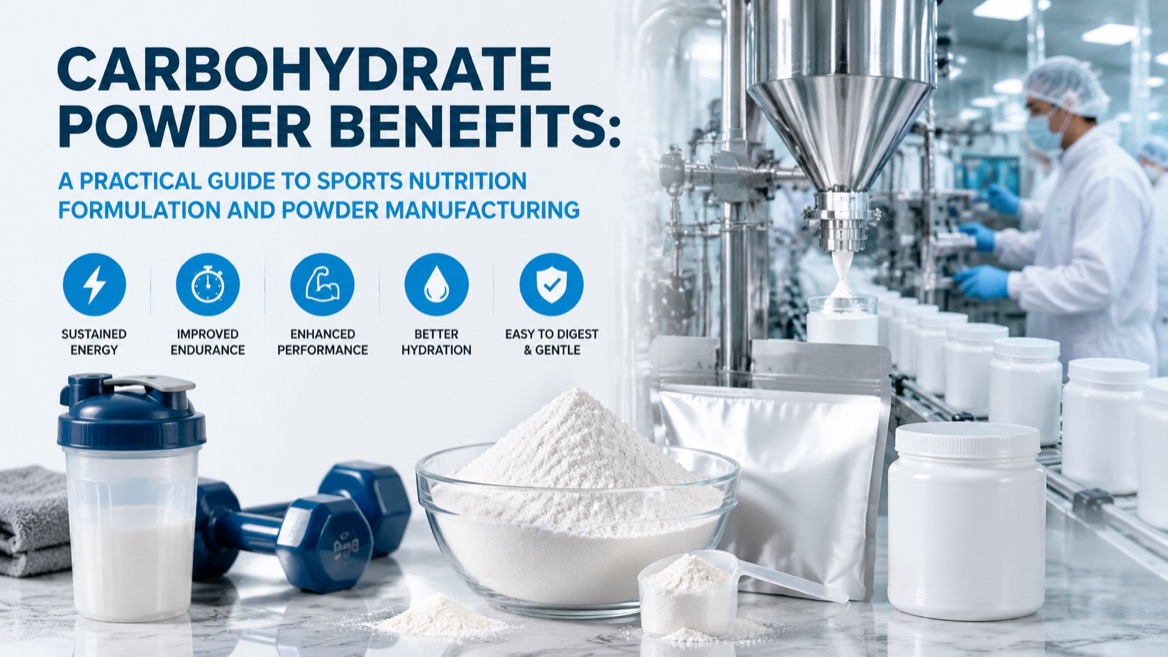
Carbohydrate powder is a versatile nutrition format for brands developing sports drinks, recovery blends, energy powders, and convenient daily nutrition products. When the carbohydrate source, serving size, flavor system, electrolyte balance, and packaging are designed around a specific use occasion, powder products can help consumers meet carbohydrate needs before, during, or after demanding activity.
For brand owners, the opportunity is not simply to sell “energy.” It is to build a clearly positioned product with an evidence-informed formula, a pleasant drinking experience, reliable batch consistency, and packaging that fits how customers actually train, travel, and refuel.

What Is Carbohydrate Powder?
Carbohydrate powder is a dry, drink-mix format that delivers carbohydrates in a measured serving. It can be formulated as a single-ingredient product or as a multi-ingredient blend with electrolytes, protein, amino acids, vitamins, minerals, flavors, sweeteners, or functional ingredients selected by the brand.
Common carbohydrate sources may include:
Maltodextrin, often used for its neutral taste and easy integration into drink powders
Dextrose, a glucose-based carbohydrate with a straightforward flavor profile
Fructose, often paired strategically with glucose-based carbohydrates in endurance-oriented formats
Highly branched cyclic dextrin, used in premium-positioned sports powder concepts
Clustered carbohydrate systems, designed around sustained-fuel or endurance positioning
Oat-, rice-, or other grain-derived carbohydrate ingredients, depending on the desired label story
Palatinose®/isomaltulose-style concepts, where a brand seeks a slower-digesting carbohydrate positioning, subject to ingredient availability and compliant claims
The appropriate carbohydrate system depends on the intended consumer, training duration, serving format, flavor target, nutrition facts panel, price point, and regional regulatory requirements.
A useful formulation principle is simple: the powder must match the moment of use. A high-carbohydrate endurance drink, a post-workout recovery formula, and a meal-support powder may all contain carbohydrates, but they should not be designed as the same product.
How Carbohydrate Powders Support Active Lifestyles
Carbohydrates are a major fuel source for physical activity. The body stores carbohydrate as glycogen, primarily in muscle and liver tissue. During moderate- to high-intensity exercise, carbohydrate availability can become especially relevant for sustaining training output.
The NIH Office of Dietary Supplements notes that athletes need adequate calories, fluids, and carbohydrates to help maintain blood glucose and replace muscle glycogen. Its cited ranges for athletes vary widely—about 3 to 10 grams of carbohydrate per kilogram of body weight per day—because needs depend on training volume, intensity, body size, and performance goals.
Energy Support During Longer Training Sessions
For activities lasting more than about one hour, a carbohydrate-electrolyte drink may offer a convenient way to consume fluid and fuel together. Research summarized in the International Society of Sports Nutrition position stand suggests that extended, high-intensity exercise can challenge fuel supply and fluid regulation; it discusses carbohydrate intake of approximately 30 to 60 grams per hour in a 6% to 8% carbohydrate-electrolyte solution for relevant endurance situations.
This does not mean every gym session requires a carbohydrate drink. For shorter or lower-intensity activity, regular food and water may be sufficient for many people. But for endurance athletes, high-volume trainers, team-sport participants, and people exercising in demanding conditions, a powdered drink mix can make intake more practical.
Post-Exercise Recovery Formulations
After strenuous exercise, carbohydrate intake contributes to glycogen replenishment. This is particularly relevant when the recovery window is short and another demanding training session or event follows soon afterward.
The sports-nutrition literature cited by the ISSN reports that higher carbohydrate feeding rates after exhaustive exercise can support rapid glycogen replenishment. It also notes that adding protein can increase glycogen resynthesis when carbohydrate intake is below high recovery targets.
For a brand, this creates several viable product directions:
A pure carbohydrate recovery powder for athletes who manage protein separately
A carbohydrate-plus-protein recovery formula
A carbohydrate-electrolyte blend for post-training hydration support
A complete recovery powder with carbohydrates, protein, electrolytes, and flavor-forward positioning
The best route depends on the audience. Competitive endurance users may prioritize carbohydrate delivery and electrolytes. Strength-training consumers may prefer a recovery blend that combines carbohydrates with protein. Mainstream fitness buyers may respond best to simplicity, taste, and easy mixing.
Convenient Fuel for Busy Consumers
Powdered carbohydrates are also used outside traditional sports categories. A brand may formulate a powder for people with active jobs, long travel schedules, outdoor activities, or difficulty consuming solid food around exercise.
However, product messaging should remain responsible. A carbohydrate powder is not a replacement for a balanced diet, and it should not be positioned as a treatment for medical conditions, appetite disorders, or blood-sugar conditions. Claims must be reviewed carefully for the target market before commercialization.
Choosing the Right Carbohydrate Powder Concept
A strong product begins with a precise commercial brief. Rather than starting with a trendy ingredient, start with the consumer’s real use case.
Endurance and Intra-Workout Drink Powder
This category is designed for consumers who need convenient fuel during extended training, races, cycling, court sports, or other physically demanding sessions.
Potential product features include:
A carbohydrate delivery target aligned with the intended serving schedule
Electrolytes such as sodium and potassium
Light flavor intensity for repeated sipping
Fast dispersion in cold water
Low foam and manageable sweetness
Single-serve stick packs for training bags and event use
A 6% to 8% carbohydrate drink concentration is commonly discussed in sports-nutrition guidance for longer exercise because it can help deliver carbohydrate without unnecessarily compromising fluid intake.
Post-Workout Recovery Powder
Recovery formulas may be developed for gym users, athletes training twice per day, team-sport participants, or consumers who want a convenient post-exercise drink.
A product brief may specify:
A carbohydrate-to-protein ratio
Plant-based or dairy-based protein compatibility
Chocolate, vanilla, fruit, or neutral flavor profiles
Added electrolytes for a recovery-and-hydration story
A high-calorie or moderate-calorie nutrition target
Pouch packaging for larger formats or sachets for on-the-go use
The formulation challenge is not only nutritional. Protein, carbohydrate type, minerals, flavors, and sweeteners must work together without excessive thickness, chalkiness, sedimentation, or aftertaste.
Clean-Label Daily Energy Powder
Some brands prefer a simpler positioning built around recognizable ingredients, lower sweetness, or a more lifestyle-oriented format. These concepts may use grain-derived carbohydrates, fruit flavors, natural flavor systems, or a limited ingredient list.
For this type of product, brands should define “clean label” internally before product development. The term has no single universal technical definition. A workable brief should clarify ingredient exclusions, allergen requirements, sweetener preferences, color preferences, target claims, and sourcing expectations.
Formulation Factors That Shape Product Quality
A carbohydrate powder can look simple on paper, but consumer experience depends on technical decisions made during development. In contract manufacturing, formula viability should be assessed before artwork and commercial launch are finalized.
Solubility and Mixing Performance
Consumers expect a powder to disperse quickly in a shaker bottle or water bottle. Poor mixing can lead to clumping, foam, residue, or a gritty mouthfeel—common reasons for poor repeat purchase.
Important development considerations include:
Particle size and ingredient flow properties
Blend uniformity
Hygroscopicity, or how readily ingredients absorb moisture
Water temperature and expected consumer mixing conditions
Scoop size or stick-pack fill weight
The relationship between serving size and recommended water volume
A formula that performs well in a laboratory sample may behave differently at commercial scale. Pilot production and organoleptic review are therefore important steps before final approval.
Flavor, Sweetness, and Drinkability
For intra-workout products, consumers may drink multiple servings over several hours. A flavor that is too sweet, too acidic, or too heavy can reduce compliance during real use.
For recovery powders, creamier flavor systems may be appropriate, especially when paired with protein. For endurance drinks, lighter citrus, berry, tropical, or unflavored profiles are often more suitable. The right choice should come from the product’s consumption context, not from flavor trends alone.
Electrolyte Compatibility
Electrolytes can add functional relevance to a carbohydrate drink, but they also influence taste, solubility, moisture behavior, and ingredient interactions. Sodium level, mineral source, acidity, flavor masking, and serving dilution all require deliberate formulation work.
A well-designed product brief identifies whether the goal is:
General hydration support
High-sweat training support
Endurance-event fueling
Post-workout recovery
Everyday active lifestyle use
These are different positioning territories and may require different formula architectures.
Powder Packaging That Fits the Use Occasion
Packaging is part of the product experience. It affects portability, serving accuracy, moisture protection, storage, and perceived value.
River Pharm Inc. supports powder product manufacturing and can work with brands on multiple packaging formats, including:
Pouches for larger-format tubs, refill concepts, or multi-serving products
Single-serve sachets for trials, retail display, travel, and daily portion control
Stick packs for slim, portable on-the-go consumption
Soft pouch formats for flexible packaging requirements
Capsule-related projects, where a brand’s product line includes multiple dosage formats alongside powder products
For carbohydrate powders, stick packs and sachets can be particularly practical because they help consumers carry pre-measured servings to a gym, race, office, or travel destination. Multi-serving pouches may suit value-oriented products or consumers who use a formula regularly at home.
Packaging selection should consider formula sensitivity. Powders containing hygroscopic ingredients may need stronger moisture-barrier protection. Serving size also matters: a high-carbohydrate endurance serving may not fit comfortably into a very small stick pack, while a concentrated product may.

From Product Idea to Commercial Batch
River Pharm Inc. provides two distinct service routes for nutrition brands.
OEM Manufacturing: You Provide the Formula
With OEM manufacturing, the brand supplies a completed formula and River Pharm Inc. manufactures it according to the agreed product specifications.
This route is appropriate when a brand already has:
A finalized formula
Ingredient specifications
A defined serving size
Packaging requirements
Finished-product standards
Label and artwork direction
The manufacturing focus is execution, process control, packaging, and delivery against defined specifications.
Custom ODM: You Provide the Direction
With custom ODM, the brand may begin with a reference product, desired ingredients, target benefits, nutrition direction, flavor preference, or intended consumer group. River Pharm Inc. then supports development and manufacturing of a tailored formula.
This route is suitable for brands that want to create a differentiated carbohydrate powder without beginning from a finished formula.
A productive custom ODM brief should include:
The intended user and usage occasion
Desired carbohydrate sources or ingredients to avoid
Target carbohydrate grams per serving
Whether electrolytes, protein, amino acids, or other ingredients are required
Flavor, sweetness, color, and sensory preferences
Packaging format and target market
Target price range and order expectations
River Pharm Inc. does not provide public-mold ODM or simple private-label replication. The objective is custom product development and manufacturing based on the brand’s direction—not a generic, off-the-shelf formula with a new label.
Quality Controls Matter in Carbohydrate Powder Manufacturing
Carbohydrate powders are food-like products, but they still require disciplined production controls. For dietary supplements in the United States, FDA requirements under 21 CFR Part 111 cover manufacturing, packaging, labeling, and holding operations. The framework is intended to help ensure products meet specifications for identity, purity, quality, strength, and composition.
FDA guidance highlights practical controls that matter to powder products, including component identity verification, process design, sanitation, protection from contamination, physical separation of packaging and labeling operations, and lot or control-number assignment.
For a brand evaluating a manufacturing partner, ask specific questions:
How are raw-material specifications established and reviewed?
How is blend uniformity assessed?
What controls reduce the risk of foreign-material contamination?
How are labels and packaging components controlled to prevent mix-ups?
How is batch traceability maintained?
What finished-product specifications are agreed before production?
What documentation accompanies the finished lot?
These questions are more useful than broad promises. They help a brand evaluate whether the manufacturing process is aligned with the product’s positioning and commercial risk profile.
Build a Carbohydrate Powder That Consumers Will Reorder
The strongest carbohydrate powder is not necessarily the one with the longest ingredient list. It is the one that delivers a clear purpose, usable serving instructions, reliable sensory performance, and a format that fits the consumer’s routine.
Whether you are planning an endurance carbohydrate drink powder, a post-workout recovery blend, a carbohydrate-electrolyte formula, or a customized daily energy product, River Pharm Inc. can support your project from formula direction through powder blending and flexible packaging.
Send us your formula, reference product, ingredient concept, or target benefit direction to discuss a custom OEM or ODM carbohydrate powder manufacturing project.
Frequently Asked Questions
What is carbohydrate powder used for?
Carbohydrate powder is commonly used to provide convenient carbohydrate intake before, during, or after exercise. Depending on the formula, it may support sports-drink, endurance-fuel, recovery, hydration, or calorie-support applications.
How much carbohydrate should an endurance drink provide?
The appropriate amount depends on exercise duration, intensity, body size, total daily diet, and the athlete’s individual tolerance. Sports-nutrition guidance commonly discusses about 30 to 60 grams per hour during prolonged exercise, often delivered in a carbohydrate-electrolyte drink.
Can carbohydrate powder be combined with protein?
Yes. Carbohydrate and protein are often combined in post-workout recovery powders. Formula design should consider serving size, protein type, flavor, sweetness, texture, solubility, and the intended nutrition profile.
Which packaging format is best for carbohydrate powder?
Stick packs and sachets are useful for portable single servings. Pouches suit multi-serving products and can offer a flexible format for regular at-home use. The best choice depends on serving size, moisture protection needs, target price, and how consumers will use the product.
Can I provide a competitor’s product as a reference for custom development?
Yes. For custom ODM development, brands can provide a reference product alongside their preferred ingredients, target effect direction, flavor expectations, and packaging needs. The development objective is a tailored formula rather than a direct public-mold or private-label copy.
Does River Pharm Inc. offer OEM manufacturing for finished formulas?
Yes. If your brand has a completed formula and product specifications, River Pharm Inc. can manufacture and package the product through its OEM service route.
Can carbohydrate powders include electrolytes or other functional ingredients?
Yes. Depending on formula feasibility and the intended market, a carbohydrate powder may be developed with electrolytes, protein, amino acids, vitamins, minerals, flavors, sweeteners, and other suitable ingredients. All product claims and labeling should be reviewed for the destination market.
References
U.S. Food and Drug Administration. “Current Good Manufacturing Practices (CGMPs) for Food and Dietary Supplements.” Accessed August 2026.
U.S. Food and Drug Administration. “Final Rule for Current Good Manufacturing Practices in Manufacturing, Packaging, Labeling, or Holding Operations for Dietary Supplements.” Accessed August 2026.
U.S. Food and Drug Administration. “Small Entity Compliance Guide: Current Good Manufacturing Practice in Manufacturing, Packaging, Labeling, or Holding Operations for Dietary Supplements.” Accessed August 2026.
National Institutes of Health, Office of Dietary Supplements. “Dietary Supplements for Exercise and Athletic Performance: Fact Sheet for Health Professionals.” Accessed August 2026.
Kerksick, C. M., et al. “International Society of Sports Nutrition Position Stand: Nutrient Timing.” Journal of the International Society of Sports Nutrition, 2017.
Jeukendrup, A. “A Step Towards Personalized Sports Nutrition: Carbohydrate Intake During Exercise.” Sports Medicine, 2014.
American College of Sports Medicine. “Exercise and Fluid Replacement Position Stand.” Accessed August 2026.
Hot Tags: Carbohydrate Powder Manufacturer, Sports Nutrition Contract Manufacturing, Custom Powder Supplement Manufacturing, Carbohydrate Drink Powder OEM, Electrolyte Powder Manufacturer, Recovery Powder Manufacturer, Dietary Supplement Powder Manufacturer, Sports Drink Powder Supplier, Custom Sports Nutrition Formula, Powder Supplement Packaging, custom, private label, manufacturing company, manufacturers, suppliers, factory, Customized, Bulk, quotation, oem
Did you find this helpful?
Comments (0)
No comments yet. Be the first to comment!
Leave a comment
Related Posts
Sep 18, 2026
Proprietary Blends vs. Transparent Labeling: Building Consumer Trust in the Competitive Keto Supplement Market
Sep 17, 2026
Pharmaceutical Grade vs. Food Grade Ingredients: Which Is Necessary for Medical-Grade Nutritional Supplements?

Sep 16, 2026
US-Based Manufacturing vs. Overseas Supplement Contract: Navigating Supply Chain Reliability in 2026
Riverpharm · Supplement Contract Manufacturing
Your supplement brand, manufactured to the highest standard
From first formula to finished product — we handle manufacturing, packaging, and fulfillment so you can focus on building your brand.
Core services
Contract Manufacturing
GMP-certified production with full batch testing and certificate of analysis on every run.
Custom Formulation & R&D
In-house scientists develop your formula from scratch or refine existing blends for efficacy.
Packaging & Labeling
Design-to-print label service — shelf-ready, FDA-compliant, and retail-tested.
FBA Prep & Fulfillment
Amazon-ready prep and direct-to-warehouse shipping — no extra steps on your end.
By the numbers
NSF
NSF/ANSI 455-2 certified
cGMP
Certified environment
24 hr
AI-accelerated quote turnaround
600K
cGMP+ encapsulator capacity per run
Why Riverpharm
Quality systems with higher standards
- NSF/ANSI 455-2 certified
- cGMP-certified environment
- In-house + third-party testing
- Source-locked ingredients
Production capacity with faster execution
- Heavy-duty hardware
- In-house core reserves
- AI-accelerated quotes
- In-house expert hub
Delivery formats we produce
Capsules
Gelatin & HPMC vegetarian
Sachets
Single-dose powder blends
Stick packs
Convenient single-serve
Pouches
Flexible, shelf-ready
Ready to bring your supplement to market?
Free consultation · 24-hour quote · No minimum commitment to get started