How to Choose a Dietary Supplement OEM/ODM Manufacturer: A Practical Guide for Brands
Learn how to choose a dietary supplement OEM/ODM manufacturer for capsules, sachets, stick packs, and pouches, with quality and development guidance.
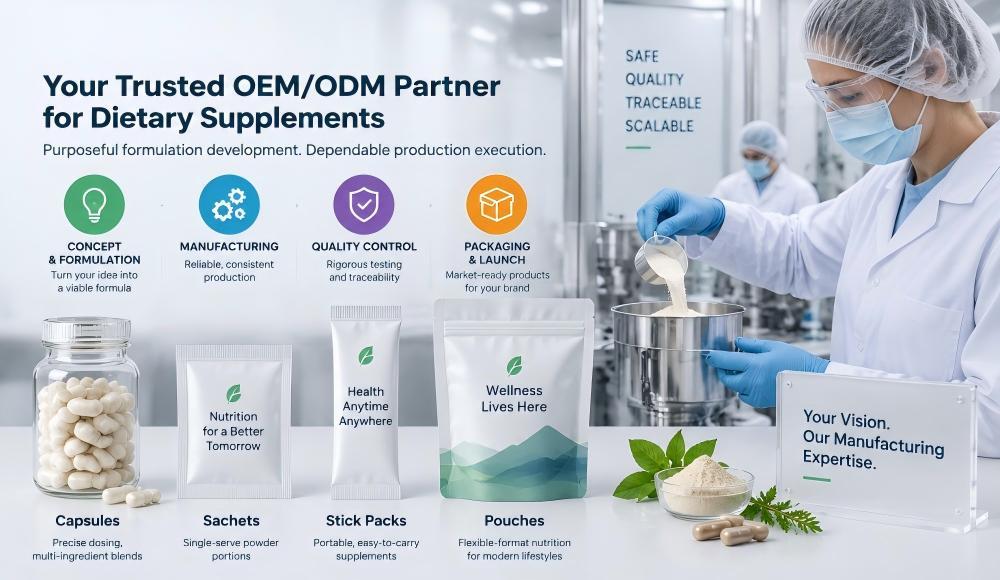
Launching a dietary supplement is not simply a matter of selecting ingredients and choosing a package. It is a manufacturing, quality-control, documentation, and brand-risk decision. For brands developing capsules, sachets, stick packs, or pouch-packed nutrition products, the right dietary supplement OEM/ODM manufacturer should be able to translate a concept or formula into a repeatable, traceable, market-ready product.
At River Pharm Inc., we work with brands that need two distinct types of support: OEM manufacturing, where the brand provides a finished formula and we manufacture it; and custom ODM development, where the brand provides a reference product, target ingredients, dosage concept, or intended functional direction, and our team develops and manufactures a new formulation. We do not offer generic stock-formula relabeling programs. Our focus is on purposeful formulation development and dependable production execution.
This guide explains how experienced supplement buyers can evaluate an OEM/ODM manufacturing partner, reduce avoidable launch risks, and build a more scalable product-development process.
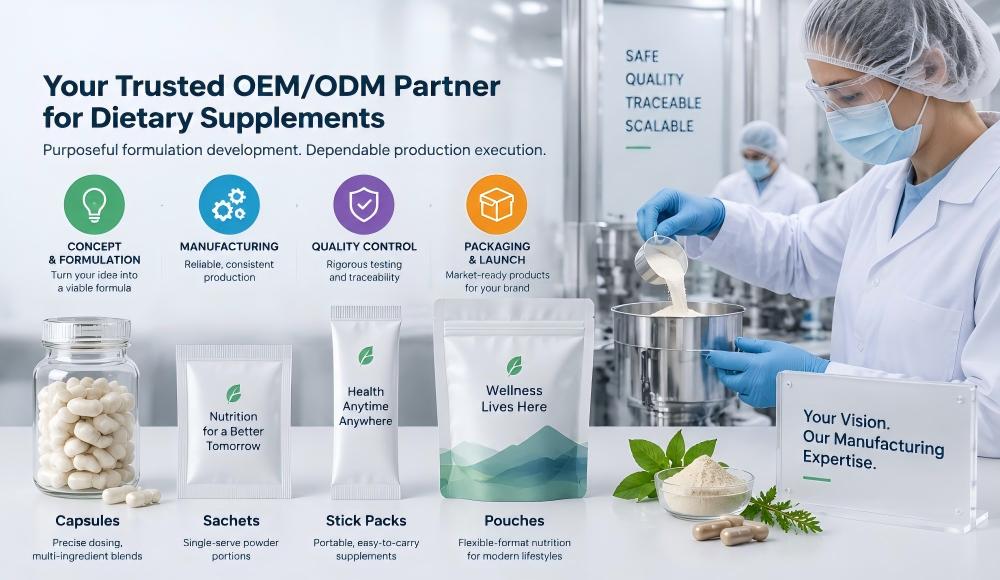
Start With the Manufacturing Model
Before comparing facilities, brands should clearly define whether they need OEM production or custom ODM development. These services solve different problems, require different timelines, and call for different levels of technical collaboration.
OEM Manufacturing: Your Formula, Our Production
OEM manufacturing is best suited to brands that already have a defined formula, including ingredient specifications, dosage levels, serving size, product format, and packaging requirements.
In an OEM project, the client typically provides:
- A complete formula or bill of materials
- Ingredient dosage and serving-size requirements
- Target dosage form, such as capsules, powder sachets, stick packs, or pouches
- Packaging format and labeling artwork
- Required testing specifications, where applicable
- Forecasted order volume and target launch timeline
The manufacturer's responsibility is to assess whether the formula can be produced consistently, source or qualify appropriate materials, establish manufacturing instructions, execute the batch, conduct required quality checks, and package the finished product according to approved specifications.
A strong OEM partner does not merely say "yes" to every formula. It should identify practical manufacturing issues before production begins. For example, a high-dose botanical blend may create poor powder flow, inconsistent fill weights, capsule-size limitations, unpleasant taste, or stability concerns. Catching these issues during the technical review is far less costly than discovering them after packaging has been printed or inventory has been produced.
Custom ODM: Your Direction, Our Formulation Work
Custom ODM is appropriate when a brand has a market opportunity but does not yet have a complete formula. The starting point may be a competitor reference product, a desired ingredient profile, a delivery format, a target consumer group, or a functional positioning concept.
For example, a brand may ask for:
- A daily wellness capsule inspired by a reference product
- A travel-friendly stick pack with selected vitamins, minerals, or botanical ingredients
- A pouch-based nutrition supplement for active adults
- A capsule formula designed around a specific nutrient combination and serving experience
- A multi-ingredient product that must fit a defined capsule count, flavor profile, or cost target
Custom ODM should be treated as a structured product-development project, not as a shortcut. A manufacturer needs to evaluate ingredient compatibility, dose feasibility, sensory performance, regulatory positioning, raw-material availability, processing behavior, packaging compatibility, and commercial viability.
The goal is not to copy a market product. The goal is to develop a product with a clear technical rationale, manufacturable specifications, and a formulation that supports the brand's own positioning.
Why Manufacturing Capability Matters
The most compelling supplement concept can fail if the chosen delivery format does not match the formula. A manufacturer's real value lies in its ability to assess this fit early and communicate practical limitations honestly.
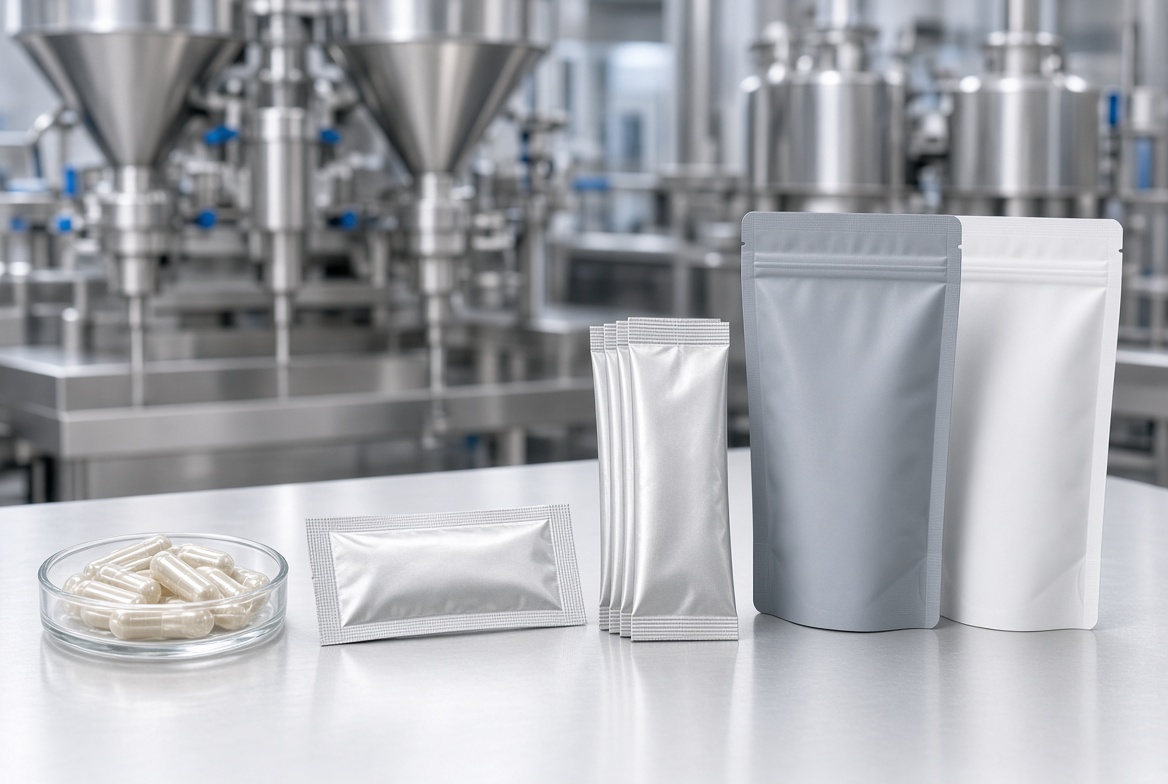
River Pharm Inc. supports the production of dietary supplements and nutritional supplements in several commonly requested formats:
- Capsules for precise dosing, multi-ingredient blends, and convenient daily use
- Sachets for single-serve powder portions and controlled consumer use
- Stick packs for portable, easy-to-carry powdered products
- Pouches for flexible-format nutritional products and retail-ready packaging needs
Each format has different requirements for ingredient flow, fill-weight control, moisture sensitivity, oxygen exposure, flavor masking, packaging integrity, and consumer convenience.
Capsules: Efficient but Not Unlimited
Capsules are a popular format because they are compact, familiar, and often well suited to vitamins, minerals, amino acids, plant extracts, and multi-ingredient blends. However, capsule development requires careful attention to bulk density and total fill weight.
A formula may look simple on paper but become difficult when the intended dose must fit into one or two capsules. Some ingredients require relatively large amounts by weight. Others have poor flowability or may need specialized excipients to support uniform filling.
Before approving a capsule project, ask the manufacturer:
- What capsule size and capsule count are required?
- Is the proposed fill weight achievable at commercial scale?
- Does the blend flow consistently through encapsulation equipment?
- Are there hygroscopic ingredients that may affect capsule integrity?
- Can the manufacturer explain the purpose of any processing aids or excipients?
- How will ingredient identity and finished-product specifications be verified?
A credible answer should include clear constraints, not just optimistic assurances.
Sachets and Stick Packs: Convenience Requires Control
Sachets and stick packs create a strong consumer experience for travel, on-the-go routines, subscriptions, sampling, and single-serve nutrition programs. They can also present additional manufacturing challenges.
Powder products must be evaluated for particle size, blend uniformity, dusting, clumping, moisture sensitivity, taste, solubility, and seal performance. A formula that performs well in a bulk container may not automatically work in a small single-serve package.
For drink mixes or flavored nutrition powders, brands should discuss:
- Target serving weight
- Desired mouthfeel and dissolution behavior
- Sweetener and flavoring strategy
- Packaging-barrier requirements
- Moisture-control needs
- Expected storage conditions
- Consumer preparation instructions
Small packaging formats can elevate product convenience, but they require disciplined process control. Inadequate powder flow or inconsistent seals can lead to fill-weight variation, leakage, product hardening, or consumer complaints.
Pouch Packaging: More Than a Design Choice
Pouches can support a wide range of commercial needs, including flexible retail presentation, portioned products, refill concepts, and nutrition powders that require more room than a stick pack. Yet packaging selection should never be based on visual appeal alone.
The packaging material must be compatible with the product. Moisture-sensitive ingredients, oils, probiotics, botanical powders, and flavor systems can all require different barrier properties. The manufacturer should be able to explain how the packaging choice relates to shelf-life expectations and product protection.
Evaluate Quality Through Evidence
A supplement manufacturer should be evaluated through documented systems, not marketing claims. In the United States, dietary supplement manufacturers, packagers, labelers, and holders must establish and follow current good manufacturing practice requirements under 21 CFR Part 111. These requirements are intended to help ensure that dietary supplements meet specifications for identity, purity, strength, composition, and limits on contamination.
For a brand owner, this means quality is not a vague promise. It should be visible in the manufacturer's process, records, controls, and willingness to answer detailed questions.
Questions Every Brand Should Ask
A serious manufacturer evaluation should include the following questions:
1. How are incoming dietary ingredients identified and released for use?
The quality system should include defined specifications and appropriate identity verification. The FDA's guidance emphasizes that firms must establish and follow manufacturing practices designed to ensure product quality and alignment with the master manufacturing record.
2. What specifications are established for the finished product?
Brands should understand how the product will be evaluated for identity, purity, strength, composition, and relevant contamination limits.
3. Who has quality-control authority?
Quality personnel should have the authority to review and approve or reject materials, processes, and finished batches. A manufacturer that treats quality review as a formality creates unnecessary risk.
4. How are batch records maintained?
Complete batch documentation supports traceability, investigation, and consistent repeat production. It should connect the approved formula, ingredient lots, processing steps, packaging components, and final release decision.
5. What happens when a result falls outside specification?
Ask how deviations, investigations, corrective actions, and product disposition are handled. The answer reveals whether the facility has a mature quality culture.
6. Can the facility support the required packaging format?
A strong formulation is only useful if the factory can reliably fill, seal, inspect, and package it in the required format.
Documentation Is a Brand Asset
Many emerging brands view documentation as a back-office requirement. In practice, it is part of brand protection.
Well-managed documentation can help a brand:
- Trace ingredient and packaging lots
- Support internal quality reviews
- Investigate complaints efficiently
- Maintain consistency across repeat orders
- Improve communication with distributors and retail partners
- Prepare for future market expansion or due diligence
The National Institutes of Health notes that supplement companies are responsible for ensuring that products are safe and that label claims are truthful and not misleading. It also notes that manufacturers must follow good manufacturing practices intended to ensure identity, purity, strength, and composition.

Match Claims to Evidence
A supplement brand's commercial language should be developed with the same care as its formula. Consumers often encounter phrases such as "supports energy," "supports immune health," or "supports healthy digestion." These statements can influence buying decisions, but they must be used responsibly.
A useful rule for product development is simple: start with substantiation, then build the claim language. Do not begin with a marketing promise and attempt to force the formula to fit it afterward.
The NIH explains that dietary supplement labels may include certain health-related statements, including structure/function claims that describe how an ingredient may support normal body structure or function. However, companies remain responsible for ensuring their claims are truthful and not misleading.
For U.S.-market products using qualifying structure/function claims, the required disclaimer should be considered during label planning:
> "This statement has not been evaluated by the Food and Drug Administration. This product is not intended to diagnose, treat, cure, or prevent any disease."
This is not simply label text to add at the end. It reflects a broader discipline: product positioning should not imply that a dietary supplement diagnoses, treats, cures, or prevents disease.
A Better Claim-Development Workflow
Use this sequence when developing a new product:
1. Define the intended consumer need in plain language.
2. Identify ingredients that are appropriate for the intended concept.
3. Review available scientific and regulatory context for those ingredients.
4. Confirm feasible ingredient forms and dosages with the manufacturing team.
5. Develop conservative, supportable positioning language.
6. Review the complete label, website copy, advertising, and sales materials for consistency.
This process helps prevent a common problem: a responsible label paired with overly aggressive online advertising. The customer sees the entire brand experience, not just the Supplement Facts panel.
Build a Better OEM/ODM Brief
The quality of the initial project brief often determines the quality of the manufacturing relationship. Vague requests create vague quotations, unclear development expectations, and avoidable revisions.
A practical brief should include the following information:
- Product concept and intended customer
- Target dosage form and packaging format
- Required ingredients, preferred ingredients, and excluded ingredients
- Target serving size and suggested use
- Reference products, if relevant
- Desired flavor, color, sensory profile, or capsule appearance
- Target market or sales region
- Packaging preferences and label requirements
- Target cost range, if available
- Initial order quantity and future volume expectations
- Desired commercial launch date
For a custom ODM project, it is helpful to separate "must-have" requirements from "nice-to-have" preferences. For example, a brand may require a specific ingredient category and a single-serve stick format, while being flexible on flavor direction or minor supporting ingredients.
That distinction allows the development team to propose realistic options instead of making assumptions.
Common Mistakes When Choosing a Manufacturer
Selecting Only by Unit Price
The lowest quoted price is not always the lowest total cost. A lower-cost option can become expensive if it leads to reformulation delays, incomplete documentation, missed delivery windows, inconsistent quality, or unusable packaging.
Evaluate cost alongside technical support, quality systems, packaging capability, communication speed, and repeat-order reliability.
Treating Formulation as a Simple Ingredient List
Ingredient names and dosages are important, but they are not the complete formula. Product performance may also depend on particle size, ingredient form, flavor compatibility, excipients, capsule capacity, processing conditions, and packaging protection.
Ignoring Scale-Up Questions
A formula that is possible in a development sample may not be efficient or stable at commercial scale. Ask early about raw-material lead times, blend uniformity, production capacity, packaging throughput, and reorder planning.
Using Disease-Oriented Marketing Language
Product positioning should focus on responsible support language rather than disease treatment or prevention claims. This protects the brand and creates a more credible consumer message.
Choosing a Generic Relabeling Model by Default
Private-label stock formulas can be useful for some business models. However, brands seeking differentiation may benefit more from custom ODM development that begins with their target concept, ingredient priorities, delivery format, and product story.
River Pharm Inc. does not support public-mold ODM or generic stock-formula relabeling. Instead, we work with clients who want to develop or manufacture products based on their own formula, reference direction, ingredient requirements, or functional concept.
What a Product-Ready Partnership Looks Like
The best manufacturer relationship is collaborative without being confusing. The brand retains ownership of its commercial strategy and product vision. The manufacturer contributes formulation practicality, production knowledge, quality-system discipline, and packaging execution.
A productive project typically moves through these stages:
1. Concept review — Confirm the business objective, format, formula status, packaging needs, and market requirements.
2. Technical assessment — Evaluate feasibility, dosage limits, ingredient compatibility, sourcing considerations, and production constraints.
3. Formula development or OEM confirmation — Finalize the manufacturable formula and specifications.
4. Packaging review — Confirm pouch, sachet, stick-pack, or capsule packaging requirements and artwork readiness.
5. Production planning — Establish material availability, scheduling, quality documentation, and batch requirements.
6. Manufacturing and quality release — Produce, inspect, document, and release the batch according to approved specifications.
7. Repeat-order improvement — Use first-run learnings to improve forecasts, packaging planning, and future production efficiency.
This approach turns manufacturing from a transactional purchase into a repeatable operating system for a growing supplement brand.
Work With River Pharm Inc.
River Pharm Inc. provides OEM manufacturing and custom ODM development for dietary supplements and nutritional supplements in capsules, sachets, stick packs, and pouches.
If you already have a formula, we can evaluate its manufacturability and help move it toward controlled production. If you have a reference product, ingredient direction, dosage-format requirement, or product concept, our custom ODM team can help develop a formulation built around your business goals.
Send River Pharm Inc. your formula, reference product, ingredient list, target format, and expected order volume to begin a technical feasibility review.
FAQ
What is the difference between supplement OEM and custom ODM?
OEM means the client provides an established formula and the manufacturer produces it. Custom ODM means the client provides a product direction, reference product, ingredient requirements, or functional concept, and the manufacturer develops and produces a new formula.
Does River Pharm Inc. offer generic private-label supplement formulas?
No. River Pharm Inc. does not offer public-mold ODM or generic stock-formula relabeling. We focus on OEM manufacturing for client-provided formulas and custom ODM development for client-specific product concepts.
Can one formula be made in capsules and stick packs?
Possibly, but each format must be evaluated separately. Capsule fill limits, powder flow, flavor, solubility, serving size, and packaging needs can differ substantially between capsules and stick packs.
Why are batch records important for dietary supplements?
Batch records support traceability and confirm that a product was manufactured according to approved instructions. They help connect the finished batch to its ingredients, processing steps, packaging materials, and quality review.
What should I provide for an OEM manufacturing quotation?
Provide the complete formula, ingredient forms and dosages, target delivery format, packaging requirements, label status, initial order quantity, target market, and desired launch timing. More complete information generally leads to a more accurate technical review and quotation.
What should I provide for a custom ODM project?
Provide a reference product or concept, target consumer, desired benefits or functional direction, ingredient preferences, excluded ingredients, delivery format, packaging requirements, target price range if available, expected order quantity, and target launch date.
Can a supplement manufacturer help evaluate packaging choices?
Yes. Packaging should be evaluated for compatibility with the product's moisture sensitivity, serving size, storage needs, sealing requirements, consumer convenience, and intended distribution environment.
References
1. U.S. Food and Drug Administration. [Small Entity Compliance Guide: Current Good Manufacturing Practice in Manufacturing, Packaging, Labeling, or Holding Operations for Dietary Supplements]. Explains current good manufacturing practice requirements under 21 CFR Part 111 for dietary supplement manufacturing, packaging, labeling, and holding operations. [fda]
2. National Institutes of Health, Office of Dietary Supplements. [Dietary Supplements: What You Need to Know]. Provides guidance on supplement quality, good manufacturing practices, label claims, and manufacturer responsibilities. [ods.od.nih]
3. National Institutes of Health, Office of Dietary Supplements. [Dietary Supplement Fact Sheets]. Provides evidence-based ingredient information and federal educational resources for dietary supplements. [ods.od.nih]
4. U.S. National Library of Medicine, PubMed Central. [Label Statements and Perceived Health Benefits of Dietary Supplements]. Discusses consumer interpretation of supplement label statements and the distinction between health-related statements and disease claims. [pmc.ncbi.nlm.nih]
5. NutraIngredients. [Three Signs You Need a New Contract Manufacturer]. Discusses the importance of reviewing quality documentation associated with each supplement lot. [nutraingredients]
6. Nutritional Outlook. [Dietary Supplement Contract Manufacturing: Staying One Step Ahead]. Discusses the growing role of quality testing, manufacturing controls, and regulatory knowledge in dietary supplement contract manufacturing. [nutritionaloutlook]
Hot Tags: Dietary Supplement Manufacturer, Supplement OEM Manufacturer, Supplement ODM Manufacturer, Contract Supplement Manufacturing, Custom Supplement Formulation, Capsule Supplement Manufacturing, Stick Pack Supplement Manufacturing, Sachet Supplement Manufacturing, Nutraceutical Manufacturing, Dietary Supplement Packaging, custom, private label, manufacturing company, manufacturers, suppliers, factory, Customized, Bulk, quotation, oem
Did you find this helpful?
Comments (0)
No comments yet. Be the first to comment!
Leave a comment
Related Posts


Riverpharm · Supplement Contract Manufacturing
Your supplement brand, manufactured to the highest standard
From first formula to finished product — we handle manufacturing, packaging, and fulfillment so you can focus on building your brand.
Core services
Contract Manufacturing
GMP-certified production with full batch testing and certificate of analysis on every run.
Custom Formulation & R&D
In-house scientists develop your formula from scratch or refine existing blends for efficacy.
Packaging & Labeling
Design-to-print label service — shelf-ready, FDA-compliant, and retail-tested.
FBA Prep & Fulfillment
Amazon-ready prep and direct-to-warehouse shipping — no extra steps on your end.
By the numbers
NSF
NSF/ANSI 455-2 certified
cGMP
Certified environment
24 hr
AI-accelerated quote turnaround
600K
cGMP+ encapsulator capacity per run
Why Riverpharm
Quality systems with higher standards
- NSF/ANSI 455-2 certified
- cGMP-certified environment
- In-house + third-party testing
- Source-locked ingredients
Production capacity with faster execution
- Heavy-duty hardware
- In-house core reserves
- AI-accelerated quotes
- In-house expert hub
Delivery formats we produce
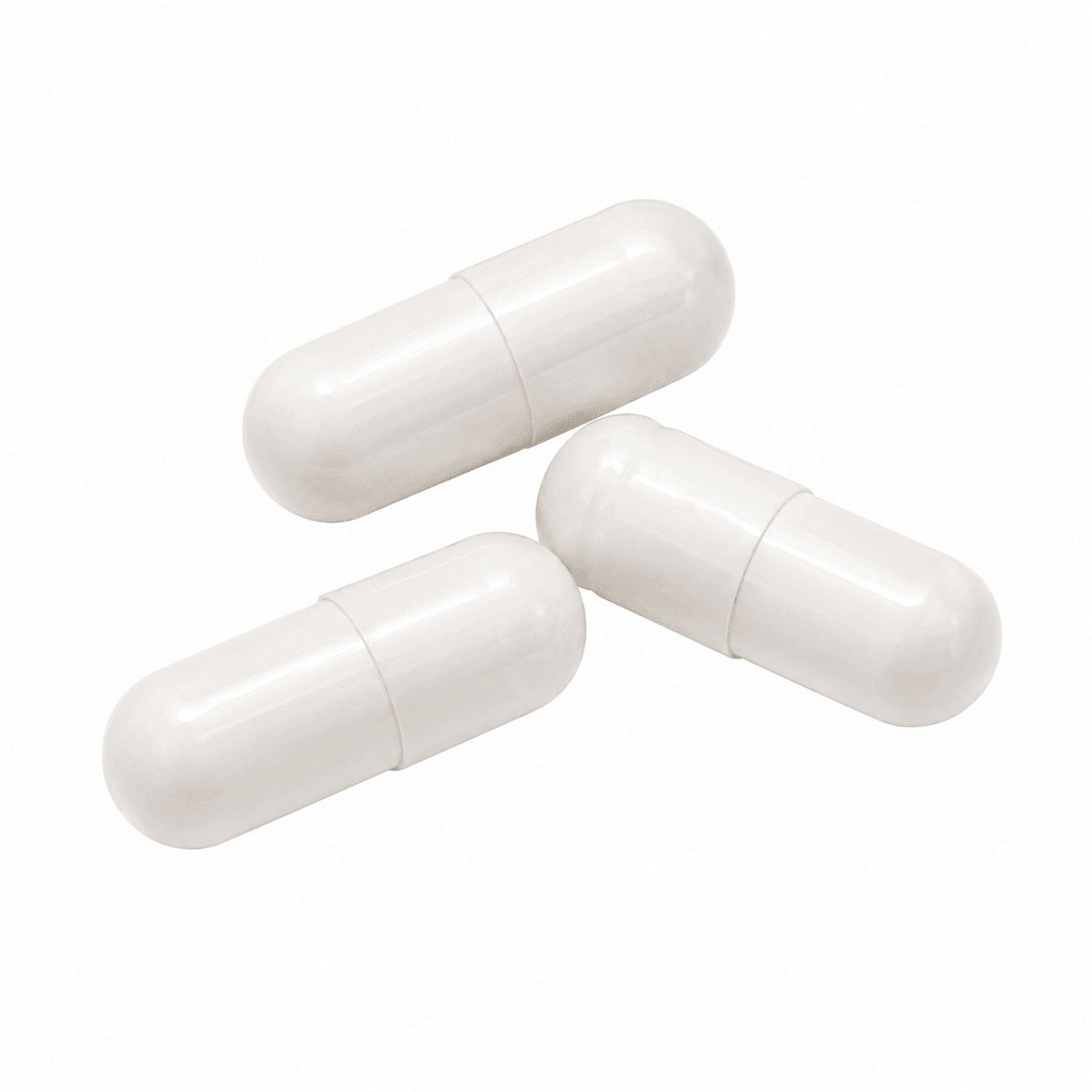
Capsules
Gelatin & HPMC vegetarian
Sachets
Single-dose powder blends
Stick packs
Convenient single-serve
Pouches
Flexible, shelf-ready
Ready to bring your supplement to market?
Free consultation · 24-hour quote · No minimum commitment to get started