Size 00 vs. Size 0 Capsules: Balancing High-Dose Potency with Consumer Swallowability in Custom Formulations
Compare size 00 vs. size 0 capsules for high-dose supplement formulas—potency capacity, swallowability data, FDA guidance, and a practical ODM sizing framework.
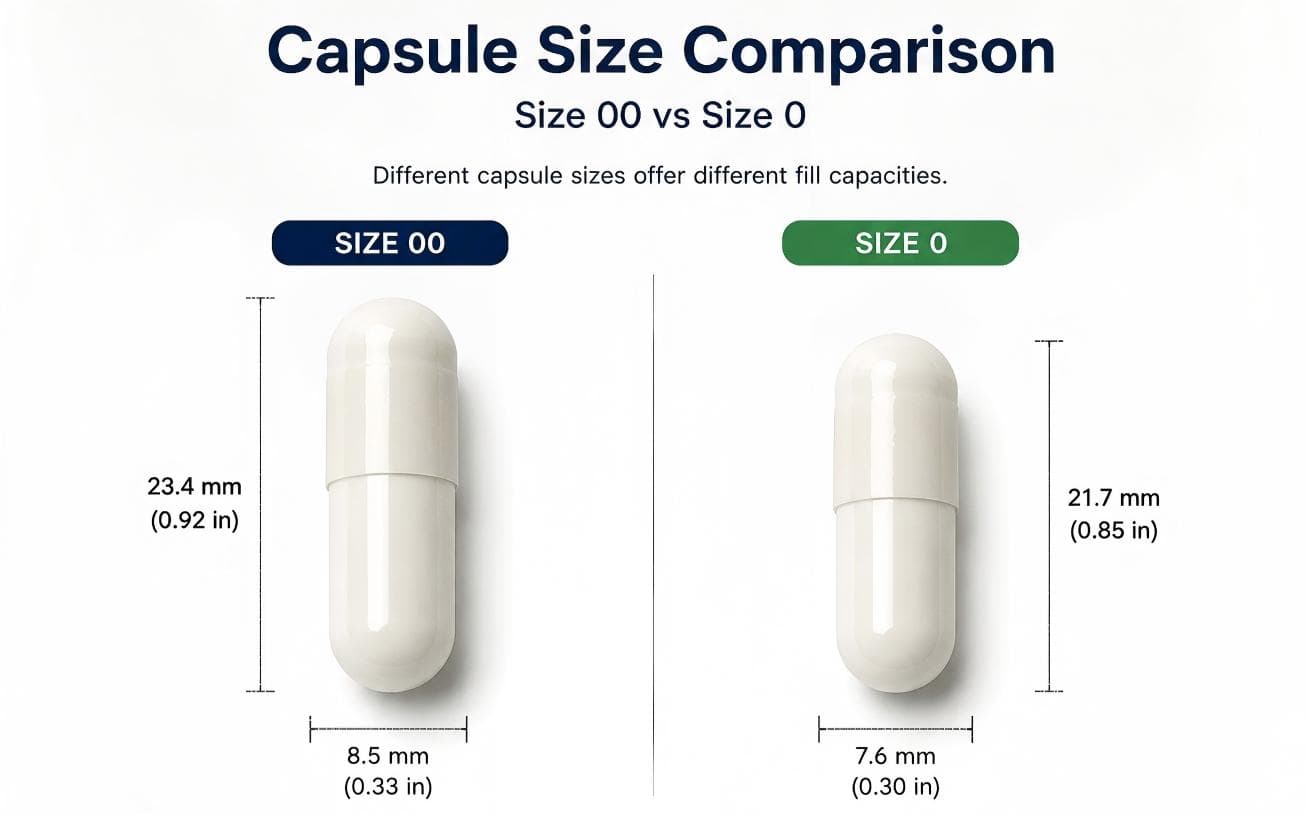
Choosing between a size 00 capsule and a size 0 capsule looks like a minor packaging detail until a formulation sheet won't fit into the shell a brand wants to use. For supplement brand owners and their manufacturing partners, capsule size is a real technical decision that shapes potency, cost per serving, and — most importantly — whether consumers will keep taking the product. As a formulation specialist advising brands on custom dietary supplement development, I've seen this "small" decision derail launch timelines more often than ingredient sourcing does.
This comparison breaks down the practical and consumer-behavior differences between size 00 and size 0 capsules, and shows how a capability-driven manufacturing partner approaches the trade-off between high-dose potency and swallowability in custom formulations.
Why Capsule Size Is a Formulation Decision
Two-piece hard capsules use a counterintuitive numbering system: the larger the capsule, the smaller the number. Size 000 is the biggest commonly used shell, while size 5 is the smallest. Sitting in the middle, size 00 and size 0 are the two most widely used sizes in the global supplement and pharmaceutical industries, striking the best balance between fill volume and swallowing comfort.
Every capsule size has a fixed internal volume, and that volume — combined with the bulk density of a powder blend — determines how many milligrams of active ingredient it can deliver. Capsule size cannot be selected in isolation; it must be worked out alongside dose, excipient load, serving size, and the intended consumer group.
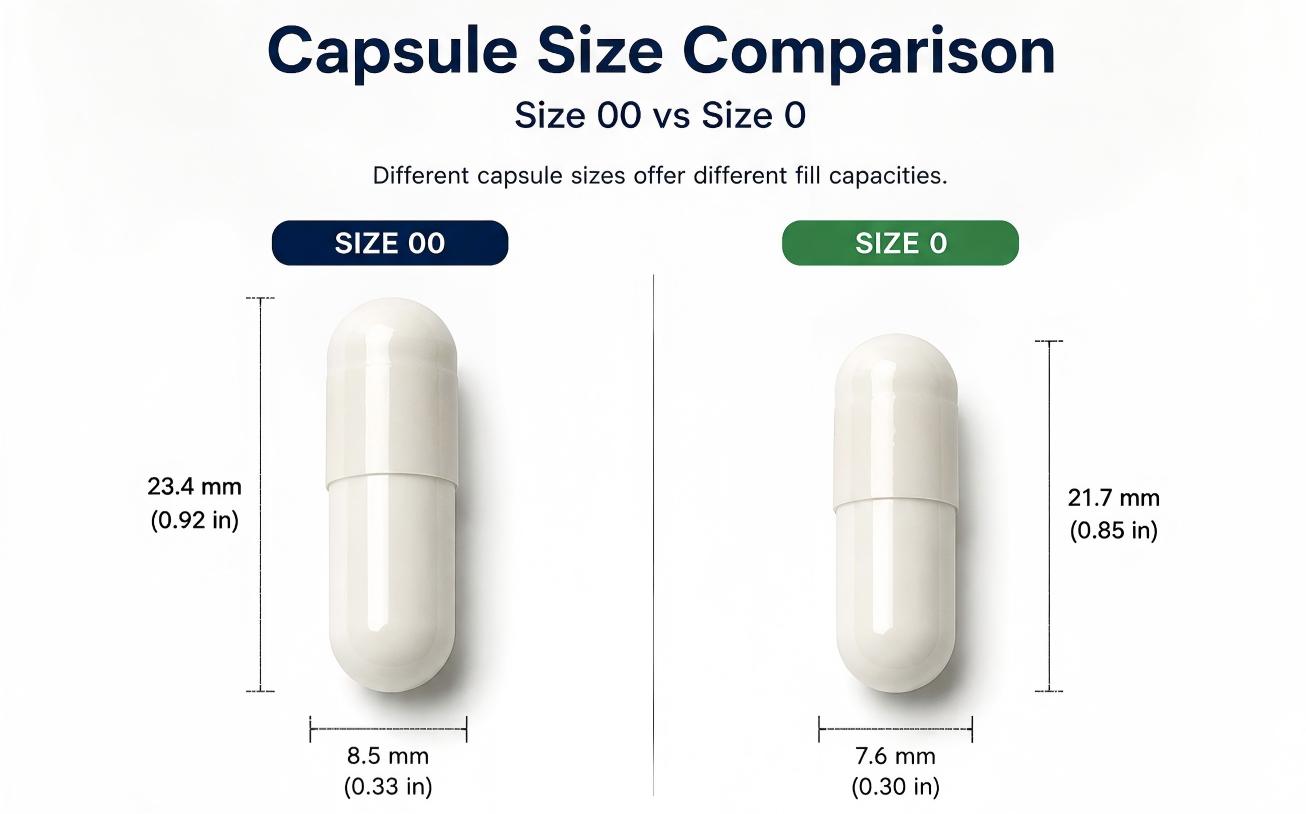
Size 00 Capsule: Specifications and Best Use Cases
A size 00 capsule has an internal volume of about 0.90 ml, an overall closed length near 23.4 mm, and an external cap diameter of roughly 8.56 mm. Depending on powder density, it typically holds 600–800 mg of fill material.
Size 00 is generally the practical ceiling for comfortable swallowing among healthy adults. It is the most common capsule size across the supplement industry, used for multivitamins, herbal blends, and extracts needing a substantial dose per capsule.
Size 0 Capsule: Specifications and Best Use Cases
A size 0 capsule holds roughly 0.68 ml internally, closes at about 21.6 mm, and has an external cap diameter near 7.64 mm. Its typical fill range is around 400–600 mg, depending on blend density.
Size 0 is the second most popular capsule format after size 00, dominating categories such as probiotics, collagen peptides, and antioxidant blends — formulations with a lower per-serving dose, or brands targeting consumers who prioritize easy swallowing over minimizing capsule count.
The Core Trade-Off: Potency Density vs. Swallowability
The tension between these two sizes comes down to one formulation reality: more active ingredient per capsule generally means a bigger capsule, and bigger capsules are measurably harder for a meaningful share of the population to swallow.
Clinical data confirms this. In a controlled study of 152 healthy adults with no diagnosed swallowing disorder, self-reported confidence in swallowing capsules dropped sharply as size increased: 93% felt confident with a size 1 capsule, but only 76% felt confident with size 00, and just 63% with size 000. Participants who already reported difficulty swallowing medication were significantly less confident specifically about size 00 and 000 capsules, with odds ratios of 0.39 and 0.47 respectively.
This isn't a niche concern. Surveys cited by Harvard Health Publishing estimate that up to 40% of American adults report gagging, choking, or vomiting when a pill or capsule doesn't go down easily, and swallowing difficulty is a documented driver of medication and supplement non-adherence. For a brand selling a daily-use supplement, that statistic directly affects reorder rates and reviews.
In short:
- Size 00 favors potency density and fewer capsules per serving, but narrows the comfortable-swallowing audience.
- Size 0 favors broader swallowability and comfort, but often requires splitting a high dose across more capsules per serving.

What Regulatory Guidance Says About Capsule Size
Capsule size intersects with recognized manufacturing and regulatory expectations. FDA guidance on the size, shape, and physical attributes of oral dosage forms recommends that the largest dimension of a tablet or capsule generally not exceed 22 mm, and that capsules intended for swallowing not exceed a standard size 00 . This guidance exists because physical attributes affecting ease of swallowing — dimension, weight, surface texture — have a direct bearing on consumer acceptance and long-term compliance .
While written primarily for generic drug products, this reflects an industry-wide understanding that also applies to supplements: size 00 sits at the practical upper boundary of what most consumers will tolerate, and pushing beyond it into size 000 introduces a swallowability risk that should only be accepted with clear justification, such as an unavoidable single-capsule high-potency claim.
The NIH Office of Dietary Supplements likewise notes that manufacturers are responsible for the identity, purity, strength, and composition of their products under current Good Manufacturing Practices, which includes ensuring the finished dosage form — capsule size included — is fit for its intended serving size and use.
A Practical Decision Framework for Custom Formulations
When a brand approaches a formulation partner with a new product concept, capsule size typically follows a structured evaluation rather than a default preference:
1. Determine the meaningful dose. Start with the amount of active ingredient the label claim requires per serving — never compromise this to fit a smaller shell.
2. Calculate bulk density of the finished blend. Fine, light powders need more volume per milligram than dense minerals, so a 500 mg dose might fit size 0 with one ingredient and require size 00 with another.
3. Decide the acceptable capsule count per serving. A one-capsule serving is a stronger sales message, but a two-capsule serving in a smaller shell can improve real-world compliance for consumers who struggle with large capsules.
4. Profile the target consumer. Sports nutrition audiences tolerate larger capsules well; products for older adults or general wellness audiences perform better in size 0 or smaller, given documented swallowing sensitivity in these groups.
5. Stress-test against filler needs. If the active dose is smaller than capsule capacity, an inert filler prevents rattling and keeps fill weight consistent — but adding filler just to justify a bigger shell wastes cost and dilutes the formula.
Why This Matters More for High-Dose Custom Formulas
Across capsule, sachet, stick pack, and soft pouch manufacturing, one pattern shows up repeatedly: brands underestimate how much fill volume a "simple" high-dose formula needs until the pilot batch is on the bench. A single-ingredient extract standardized to a specific potency percentage often requires two to three times the raw material weight of a synthetic equivalent to hit the same active dose — pushing a formulation designed for size 0 straight into size 00 or beyond.
This is where the difference between OEM and ODM manufacturing becomes important. In a traditional OEM arrangement, the brand provides a finalized formula, and the manufacturer produces it according to the specified requirements, including the selected dosage form and capsule size. In a custom ODM partnership, however, the brand can work with the manufacturer's formulation team from an earlier stage. The development process considers the target dosage, ingredient characteristics, capsule capacity, and consumer experience together to create a more practical product solution.
Instead of simply selecting an existing private-label formula, a true custom ODM process evaluates capsule size as part of the overall formulation design. Through ingredient selection, powder property assessment, formulation adjustment, and dosage form evaluation, manufacturers can help brands develop products that balance active ingredient levels, serving size, stability requirements, and user convenience — ensuring the final product is both commercially viable and suitable for market expectations.

Consumer Trends Reinforcing the Swallowability Conversation
Format preference data adds another layer here. Even as gummies, powders, and ready-to-drink formats have grown, pill-style formats — including capsules — still account for roughly a third of U.S. dietary supplement market sales, remaining the leading single format overall per recent industry reporting. Capsules are not a legacy format brands are phasing out; they remain a primary battleground for product experience.
The same reporting notes that the earlier decline of pill formats has partly reversed, with consumers returning to trusted, familiar delivery methods even as newer formats compete for attention. For brands staying in the capsule category, this makes the size 00 vs. size 0 decision more consequential — swallowability is a genuine differentiator, not a background detail.
Common Mistakes to Avoid
- Defaulting to size 00 "just to be safe." Oversized capsules with excess filler create a bulkier, harder-to-swallow product without any potency benefit.
- Ignoring ingredient density during reformulation. Switching a raw material supplier can quietly change bulk density enough to push a formula out of its original capsule size.
- Overlooking the target demographic. A joint-health formula for older adults deserves a different swallowability standard than a pre-workout for younger athletes.
- Treating capsule size as fixed before formulation work begins. The efficient path lets dose and density inform size — not the reverse.
Getting Capsule Sizing Right From the Start
Capsule size is one of the few formulation variables consumers experience directly, every time they open the bottle. Getting the size 00 vs. size 0 decision right means correctly balancing label-claim potency, ingredient density, and real-world swallowing comfort — the difference between a product that gets finished and one left on the nightstand.
If your brand is developing a high-dose formula and is unsure whether it belongs in a size 00 or size 0 capsule — or needs a partner who can engineer the blend to fit either — River Pharm Inc's formulation team works through this exact evaluation for every custom project, from ingredient direction through finished capsule, sachet, stick pack, or soft pouch production. Reach out to discuss your formulation and packaging requirements before your next production run.
Frequently Asked Questions
1. What is the main difference between a size 00 and size 0 capsule?
Size 00 is larger, holding roughly 600–800 mg with an internal volume near 0.90 ml, while size 0 is smaller, holding roughly 400–600 mg with an internal volume near 0.68 ml. Size 00 favors higher potency per capsule; size 0 favors easier swallowing.
2. Which capsule size is easier to swallow?
Size 0 is generally easier to swallow for most consumers than size 00. Research shows self-reported swallowing confidence drops as capsule size increases, with confidence measurably lower for size 00 and above.
3. Can a high-dose formula always fit in a size 0 capsule?
Not always. If the required dose exceeds what a size 0 capsule can hold at the blend's bulk density, the formulation needs a larger capsule, a multi-capsule serving, or reformulation using denser carriers or granulation to reduce fill volume.
4. Is there a regulatory limit on capsule size for supplements?
Guidance developed for pharmaceutical generics recommends that capsules generally not exceed a standard size 00 and that the largest dimension of an oral dosage form not exceed 22 mm, reflecting broader concerns about swallowability .
5. How does an ODM manufacturer decide on capsule size for a custom formula?
A qualified ODM partner evaluates the required dose, the bulk density of the finished blend, the target consumer's swallowing tolerance, and desired capsule count per serving, then engineers the formulation — including particle size and carrier selection — to fit the most appropriate capsule size rather than treating size as fixed in advance.
6. Do older consumers need smaller capsules?
Often, yes. Swallowing difficulty is more common in populations with age-related conditions or prior choking experiences, and research links reduced confidence in swallowing large capsules to these groups, making size 0 or smaller a frequent choice for supplements targeting older adults.
References
1. U.S. Food and Drug Administration. "Size, Shape, and Other Physical Attributes of Generic Tablets and Capsules — Guidance for Industry." [FDA.gov]
2. National Institutes of Health, Office of Dietary Supplements. "Dietary Supplements: What You Need to Know." [ods.od.nih.gov]
3. Radhakrishnan, C., Forough, A.S., Cichero, J.A.Y., et al. "A Difficult Pill to Swallow: An Investigation of the Factors Associated with Medication Swallowing Difficulties." Patient Preference and Adherence, 2021. [PMC — National Library of Medicine]
4. Salamon, M. "When Pills Pose Problems." Harvard Health Publishing, Harvard Medical School. [health.harvard.edu]
5. NutraIngredients. "Supplement Delivery Formats: What's Driving Consumer Choice?" [nutraingredients.com]
6. LFA Machines. "Capsule Size Guide | Interactive Specification Chart." [lfacapsulefillers.com]
Hot Tags: Capsule Size Comparison, Size 00 Capsules, Size 0 Capsules, High-Dose Formulation, Custom Supplement Manufacturing, OEM ODM Supplements, Dietary Supplement Encapsulation, Swallowability Testing, Contract Manufacturer, Nutraceutical Formulation Development
Did you find this helpful?
Comments (0)
No comments yet. Be the first to comment!
Leave a comment
Related Posts

Sep 20, 2026
Carbohydrate Powder Benefits: A Practical Guide to Sports Nutrition Formulation and Powder Manufacturing
Sep 18, 2026
Proprietary Blends vs. Transparent Labeling: Building Consumer Trust in the Competitive Keto Supplement Market
Sep 17, 2026
Pharmaceutical Grade vs. Food Grade Ingredients: Which Is Necessary for Medical-Grade Nutritional Supplements?
Riverpharm · Supplement Contract Manufacturing
Your supplement brand, manufactured to the highest standard
From first formula to finished product — we handle manufacturing, packaging, and fulfillment so you can focus on building your brand.
Core services
Contract Manufacturing
GMP-certified production with full batch testing and certificate of analysis on every run.
Custom Formulation & R&D
In-house scientists develop your formula from scratch or refine existing blends for efficacy.
Packaging & Labeling
Design-to-print label service — shelf-ready, FDA-compliant, and retail-tested.
FBA Prep & Fulfillment
Amazon-ready prep and direct-to-warehouse shipping — no extra steps on your end.
By the numbers
NSF
NSF/ANSI 455-2 certified
cGMP
Certified environment
24 hr
AI-accelerated quote turnaround
600K
cGMP+ encapsulator capacity per run
Why Riverpharm
Quality systems with higher standards
- NSF/ANSI 455-2 certified
- cGMP-certified environment
- In-house + third-party testing
- Source-locked ingredients
Production capacity with faster execution
- Heavy-duty hardware
- In-house core reserves
- AI-accelerated quotes
- In-house expert hub
Delivery formats we produce
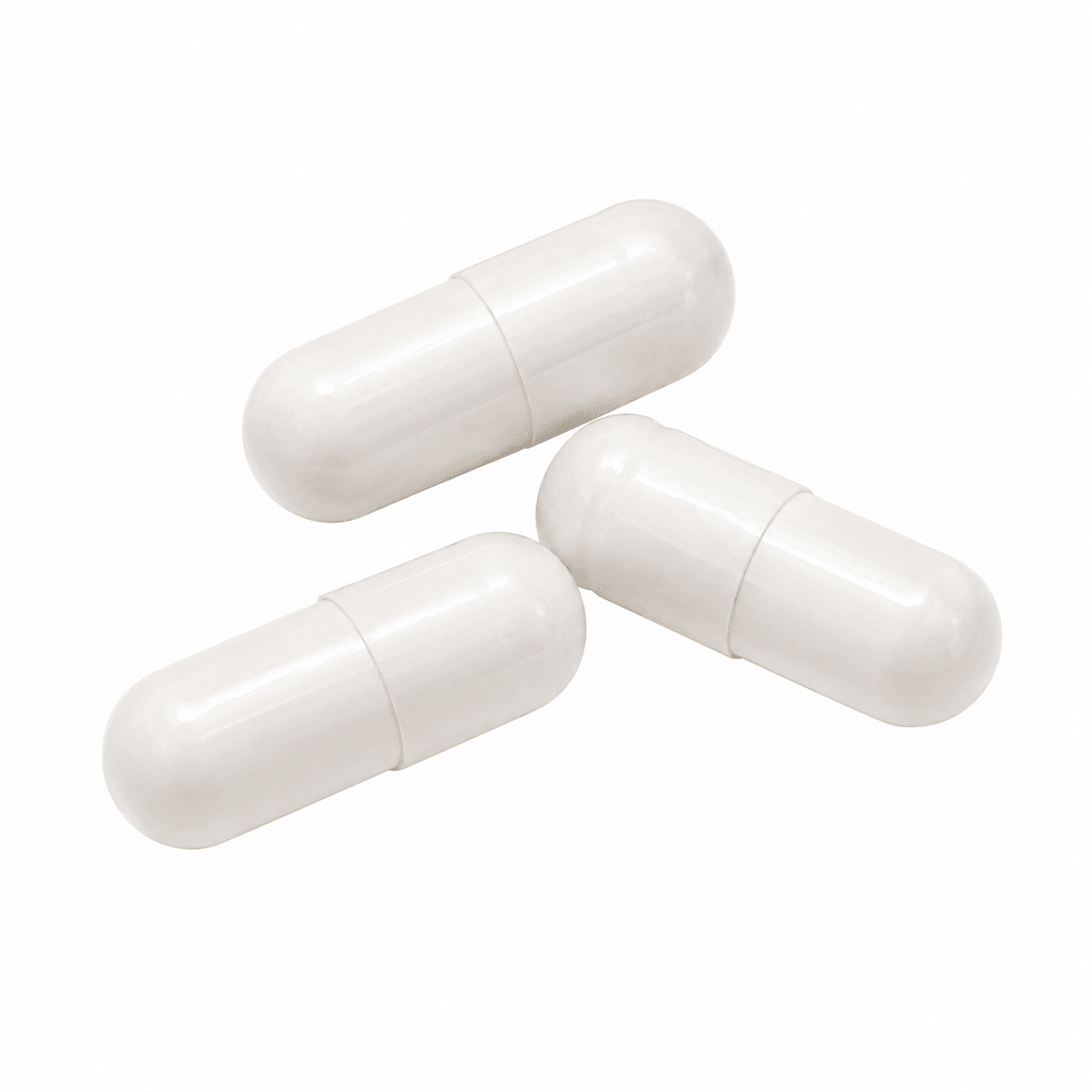
Capsules
Gelatin & HPMC vegetarian
Sachets
Single-dose powder blends
Stick packs
Convenient single-serve
Pouches
Flexible, shelf-ready
Ready to bring your supplement to market?
Free consultation · 24-hour quote · No minimum commitment to get started