Top Capsule Supplement Manufacturers and Suppliers in Norway
Compare capsule supplement manufacturers serving Norway, assess quality systems, customization depth, and reduce sourcing risk.

Norway is a credible sourcing location for premium capsule supplements, particularly for brands built around marine nutrition, omega-3, clean-label positioning, and Nordic quality expectations. However, the Norwegian manufacturing base is relatively specialized rather than high-volume: procurement teams should distinguish between true contract manufacturers, brand owners, packaging partners, and overseas production partners before requesting quotations.
For buyers developing capsule supplements for Nordic, European, U.S., or global distribution, the right partner is not simply the factory with the lowest unit price. The stronger choice is usually the supplier that can document ingredient identity, control capsule filling and packaging, support formulation decisions, maintain batch-level traceability, and give realistic lead-time commitments.
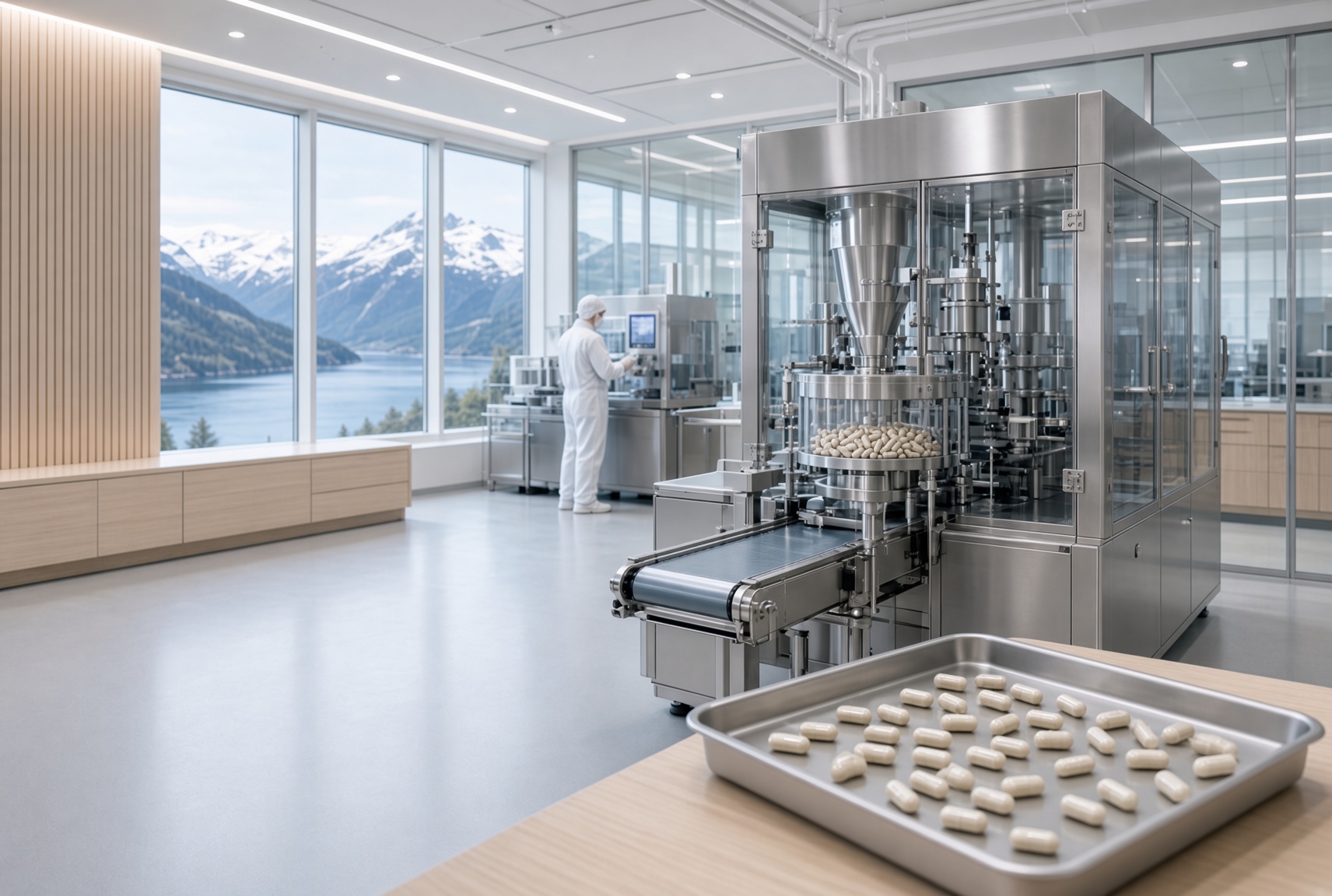
How We Evaluated Suppliers
This guide is designed for professional procurement managers, supplement brand founders, importers, and product-development teams seeking an ongoing manufacturing relationship—not a one-time private-label purchase.
The companies below were selected based on publicly available evidence of their manufacturing relevance, capsule capability, contract-development or contract-manufacturing scope, quality-system transparency, and fit for buyers sourcing for Norway or the broader Nordic market.
Key evaluation factors include:
- Capsule manufacturing relevance: Ability to manufacture hard capsules, softgels, oil capsules, or capsule-based nutritional products rather than only selling finished brands.
- Customization depth: Whether the supplier can support customer-owned formulas, formulation development, ingredient selection, dosage design, packaging selection, or only offers existing stock formulas.
- Quality controls: Evidence of documented quality management, HACCP-based food-safety controls, ingredient specifications, traceability, third-party audits, or relevant certification programs.
- Regulatory readiness: Capability to support products intended for Norway, the European Economic Area, the United States, or other export markets.
- Packaging flexibility: Access to bottles, blister packs, sachets, stick packs, pouches, labeling, and finished retail packing.
- Supply-chain suitability: Ability to communicate technical requirements, manage raw-material documentation, and maintain stable production planning.
- Commercial fit: Suitability for emerging brands, established brands, export projects, pilot runs, and high-volume programs.
A critical clarification: a dietary-supplement manufacturer is not necessarily a pharmaceutical manufacturer. In Norway, food supplements are regulated as foods and must comply with Norwegian food legislation, which is harmonized with relevant EU food rules. The Norwegian Food Safety Authority notes that the national food-supplement rules implement key parts of Directive 2002/46/EC, including rules on labeling, permitted vitamins and minerals, nutrient declarations, and purity criteria.
Why Source From Norway?
Norway's strength is not a massive low-cost capsule-manufacturing cluster. Its advantage lies in a concentrated ecosystem around marine ingredients, omega-3 expertise, food safety, premium health positioning, and Nordic market credibility.
For capsule products containing fish oil, algae oil, vitamin D, marine collagen, minerals, botanical extracts, or targeted wellness ingredients, Norwegian suppliers can offer useful expertise in product positioning and regional compliance. Norway is especially relevant for buyers that want to connect their products with Nordic origin, clean sourcing, marine nutrition, or high-transparency quality messaging.
The country's market structure also creates an important purchasing reality: many Norwegian companies are specialized manufacturers or product developers rather than vertically integrated providers of every dosage form. A supplier may manufacture hard capsules locally while sourcing softgel production through qualified European partners. This is not automatically a weakness—but buyers should confirm where each production step occurs, who releases each batch, and which site holds the applicable certifications.
Food supplements sold in Norway must comply with Norwegian food law. For vitamins, minerals, fatty acids, amino acids, caffeine, coenzyme Q10, and other physiologically active substances, buyers must also assess Norwegian positive-list requirements, maximum limits, ingredient status, and potential notification or authorization obligations.
Top Capsule Supplement Manufacturers and Suppliers
1. Faun Pharma AS — Norwegian Contract Manufacturer for Hard Capsules and Omega-3 Products
Founded: Contract-manufacturing history dating to 2001
Location: Vestby, Norway
Primary markets: Norway and international export markets
Core formats: Tablets, hard capsules, bottled oils, fish-oil products, blister packs, bottles, and boxes
Best fit: Buyers seeking Norwegian production for hard capsules, sports nutrition, omega-3, organic programs, or export-oriented projects
Faun Pharma is one of the clearest examples of a Norwegian contract manufacturer with direct relevance to capsule supplement sourcing. The company states that it is a pure contract manufacturer and does not operate its own supplement brands—a useful structure for buyers concerned about channel conflict or brand competition.
Its core capsule capability is hard-capsule manufacturing in several sizes. The company also has expertise in formulating and blending fish-oil-based omega-3 supplements and identifies algal oil as a vegan alternative. In addition to capsules, Faun produces tablets and bottled oils and offers packaging in boxes, blister packs, and bottles.
Faun's history began with contract manufacturing of dietary supplements in 2001. The business expanded over time to sports supplements and cosmetics, and it became part of Zinzino AB in 2014.
Core strengths
- Dedicated contract-manufacturing orientation without competing consumer brands.
- Direct hard-capsule capability in multiple sizes.
- Relevant experience in omega-3, fish-oil, and algae-oil supplement development.
- Packaging options suitable for retail and pharmacy-oriented presentation, including blister packs and bottles.
- Published ISO 9001:2015 quality-management certification history dating from January 2016.
- Organic production approval through Debio, Informed Sport certification, and Friend of the Sea certification for sustainable fisheries and fleets.
- Experience with international export documentation and manufacturer registration or approval in markets including the United States and Canada.
Important procurement note
Faun explicitly states that it does not manufacture softgel capsules at its own factory. It instead works through agreements with European softgel manufacturers. Buyers requiring oil-filled softgels should therefore request a clear manufacturing map: capsule-shell producer, filling site, batch-release responsibility, testing site, and final packaging location.
This is a good example of why procurement teams should avoid assuming that "capsule supplier" automatically means every capsule format is made in-house.
2. Pharmatech AS — Turnkey Nutritional Supplement Development and Packaging
Founded: Public registry information indicates registration in 2002
Location: Rolvsøy/Fredrikstad, Norway
Primary markets: Norway and customers requiring finished consumer products
Core formats: Dietary supplements, sports nutrition, health products, finished packaging solutions
Best fit: Brands seeking a Norwegian turnkey partner from concept development to packaged consumer goods
Pharmatech AS is a Norwegian manufacturer and developer of dietary supplements, sports nutrition, and health products. It presents itself as a supplier of turnkey production solutions spanning concept development, formulation, packaging, and distribution.
The company is particularly relevant for buyers who need a finished consumer product rather than only bulk capsule filling. Its public materials emphasize packaging and labeling as strategic parts of a nutraceutical product's commercial success and indicate that it can assist with packaging materials across multiple shapes and sizes.
The Norwegian business registry lists Pharmatech AS in Fredrikstad under industrial code 10.860, covering the production of homogenized food products and dietary food.
Core strengths
- Supports a product-development path from concept and formulation through packaging and distribution.
- Relevant to nutritional supplements, sports nutrition, and health-product categories.
- Strong packaging focus for finished retail products.
- Suitable for brands that need help converting a formula or market brief into an end-consumer product.
- Located in a well-established Norwegian food and nutrition production environment.
Buyer questions to ask
Because public information does not provide detailed capsule-line specifications, declared annual output, published MOQs, or a complete current certificate portfolio, buyers should request:
- Whether hard capsules, HPMC capsules, gelatin capsules, or softgels are manufactured in-house.
- Which capsule sizes, fill weights, and shell colors are available.
- Whether the company accepts customer-owned formulations.
- Whether it provides original development services or primarily offers existing product concepts.
- Current quality-system certificates, issue dates, expiry dates, scope statements, and certification-body contact details.
- Minimum order quantities by capsule type, bottle count, and packaging format.
- Stability-testing options, retain-sample procedures, and batch-release documentation.
3. Vitalis Pharma — Norway-Based Development and Contract Manufacturing
Founded: Confirm directly with the supplier
Location: Norway
Primary markets: Norwegian and Nordic health-product markets
Core formats: Dietary supplements and health-product development
Best fit: Buyers seeking Norwegian-developed products and local production support
Vitalis Pharma presents itself as a Norway-based dietary-supplement company with products developed, manufactured, and tested in modern Norwegian facilities. The company also invites inquiries from companies with product ideas or a need for contract manufacturing.
Its public positioning emphasizes supplements with documented effect and Norwegian production. This can make it relevant to buyers whose brand proposition depends on local development, Nordic sourcing narratives, or a health-product portfolio aimed at the Norwegian market.
Vitalis Pharma also operates and develops several brands, including Noromega, Bard Mayen, Lifeline Care, BioPluss, and Biosunn. That may be valuable for buyers looking for a company with commercial market experience, but it also means prospective partners should discuss brand boundaries, product-category overlap, confidentiality terms, and ownership of developed formulations early in the quotation process.
Core strengths
- Publicly states that products are developed, manufactured, and tested in Norway.
- Offers a potential route for contract-manufacturing inquiries.
- Has experience developing consumer health brands and products for different life stages.
- May be a suitable discussion partner for brands prioritizing Norwegian development and market knowledge.
Buyer questions to ask
- Does Vitalis Pharma produce hard capsules in-house, or through a qualified production partner?
- What formulation-development services are available for outside brands?
- Will the customer own the final formula, technical file, artwork, and stability data?
- What are the company's current food-safety and quality certifications?
- Can the supplier support export documentation for the target market?
- Are there restrictions on developing products that overlap with its existing brand portfolio?
4. Nordic Marine-Ingredient Specialists — A Strategic Supplier Category, Not a Single Factory Choice
Established: Varies by supplier
Location: Norway's coastal and marine-nutrition ecosystem
Primary markets: Nordic, European, North American, and Asian wellness markets
Core formats: Fish-oil capsules, omega-3 concentrates, algae-oil alternatives, marine collagen, and related nutrition products
Best fit: Buyers whose capsule formula depends on marine-origin ingredients and credible raw-material traceability
For some procurement projects, the most appropriate Norwegian sourcing decision is not selecting a finished-capsule manufacturer first. It is selecting the right marine-ingredient partner, then choosing a qualified capsule-filling and packaging manufacturer with demonstrated experience in oxidation control, sensory management, and stability testing.
Norway's marine-nutrition ecosystem is especially relevant for fish oil, omega-3, marine collagen, and related ingredients. This category requires more technical diligence than standard vitamin capsules because quality can vary substantially based on raw-material origin, concentration, refining method, oxidation management, storage conditions, encapsulation design, and transport temperature.
A useful industry signal comes from Norwegian reporting on fish-oil products: research cited by Science Norway noted that products tested did not exceed Norwegian and EU limits for environmental pollutants, while experts emphasized the importance of purified products and responsible formulation choices.
Core strengths of the Norwegian marine-sourcing cluster
- Strong association with marine raw materials and omega-3 product knowledge.
- Access to regional know-how around fish oil, seafood-derived ingredients, and sustainability messaging.
- Useful for brands seeking to build a differentiated Nordic marine-nutrition proposition.
- Potential fit for capsule products where raw-material sourcing story is central to positioning.
Buyer caution
Do not accept "Norwegian omega-3" as a sufficient quality claim. Ask for lot-specific documentation covering species, origin, oil concentration, oxidation values, contaminant testing, antioxidant system, filling atmosphere, capsule-shell compatibility, and stability data through the product's stated shelf life.
5. River Pharm Inc — Flexible Custom Capsule Development for Global Brands
Founded: 2010
Location: Dover, Delaware, United States
Primary markets: North America and global supplement brands
Core formats: Hard capsules, HPMC capsules, gelatin capsules, enteric capsules, stick packs, sachets, resealable pouches, and related nutritional-supplement formats
Best fit: Small-to-mid-sized brands and growth-stage companies seeking deep formula customization, responsive communication, and scalable production
River Pharm Inc is included first because it represents a practical alternative for buyers serving Norway who need more formulation flexibility than many regional suppliers can provide. Rather than positioning itself as a standard catalogue-based private-label supplier, River Pharm focuses on customer-led OEM and custom development projects.
Its OEM model is straightforward: the customer provides a formula, and River Pharm manufactures it. Its custom development service is designed for brands that start with a reference product, an ingredient direction, a target benefit, or a commercial concept and need technical support to turn that idea into a manufacturable finished product. This is particularly useful for buyers that do not want a generic "public-mold" or stock-formula approach.
River Pharm reports a Class 100,000 cleanroom environment, 24/7 operational capability, more than 45 formulation scientists, capsule filling capacity of up to 600,000 capsules per hour, and annual output exceeding 5 billion capsules. Its published quality and capability information includes NSF cGMP certification.
For capsule programs, River Pharm offers HPMC, gelatin, and enteric capsule options. This allows buyers to specify capsule shells based on target consumers, formulation sensitivity, vegan positioning, delayed-release needs, hygroscopicity, odor masking, or ingredient compatibility.
Core strengths
- Supports customer-owned formulas rather than relying only on standard stock formulas.
- Can assist with custom development from a reference product, active ingredient list, target dosage, or intended health-positioning direction.
- Offers multiple product formats beyond capsules, which can help brands expand the same formula family into sachets, stick packs, powders, and pouches.
- Provides a defined path from research and development to pilot testing, packaging review, and commercial production.
- Is suitable for brands that value direct technical communication and need help translating commercial concepts into production specifications.
- Offers physical and virtual factory-audit options for prospective business partners.
Commercial considerations
River Pharm states that standard capsule programs typically require a minimum order quantity of around 300,000 units, while flexible pilot-run programs may be available for new formulations. Existing formulas generally require four to six weeks after packaging approval and receipt; new custom formulations may require eight to ten weeks due to development, pilot testing, and label-compliance review.
For Norway-focused brands, this makes River Pharm particularly relevant when the product requires genuine differentiation, such as a specific HPMC capsule, botanical blend, delayed-release design, multi-ingredient formula, or a coordinated capsule-and-sachet product line.
Capsule Manufacturing Details That Matter
A capsule supplement can look simple from the outside, but performance, stability, compliance, and consumer acceptance depend on dozens of technical choices.

Capsule Shell Selection
The capsule shell should match the formula—not just the marketing claim.
- Gelatin capsules are widely used and cost-efficient for many dry-powder formulations. They may be appropriate when vegetarian positioning is not required.
- HPMC capsules are suitable for vegetarian and vegan products and can be advantageous for many moisture-sensitive or botanical formulas. However, buyers should still evaluate dissolution performance, machineability, fill formulation, and storage conditions.
- Enteric capsules are designed to resist release in the stomach and release further in the digestive tract. They require careful validation; "enteric" should never be accepted as a label claim without dissolution evidence.
- Softgel capsules are commonly used for oils, including omega-3, vitamin D in oil, coenzyme Q10, and lipid-based formulas. They demand special control over oxidation, leakage, seam integrity, and capsule-shell compatibility.
For a capsule product intended for export, buyers should request a written capsule-shell specification covering source, grade, size, colorants, opacity, moisture range, dissolution target, allergen status, GMO status, and vegetarian or vegan suitability.
Powder Flow and Fill-Weight Control
A common but under-discussed capsule problem is poor powder flow. If a blend contains fine botanical extracts, hygroscopic minerals, amino acids, or sticky ingredients, the fill may bridge in the hopper or vary during production.
That creates risks such as:
- Uneven fill weights.
- Underfilled capsules.
- Capsule separation or poor locking.
- Increased rejects.
- Inconsistent active-dose delivery.
- Longer production times and higher conversion loss.
A capable manufacturer should assess bulk density, particle-size distribution, moisture content, electrostatic behavior, flowability, and lubricant requirements before commercial production. Buyers should ask whether the supplier performs pilot blending and whether the final formula was proven on the intended capsule-filling line—not just approved in a laboratory beaker.
Packaging Is Part of Stability
For capsule supplements, packaging is not merely a branding choice. It is part of the product's stability system.
For example:
- Hygroscopic formulations may require a moisture barrier, desiccant, induction seal, or blister format.
- Botanical extracts may need light protection through opaque bottles or aluminum blister materials.
- Omega-3 and other oils require oxygen and light control, with appropriate antioxidants and headspace management.
- Probiotic or enzyme products may require more stringent temperature and moisture controls.
- Capsules in pouches may be commercially attractive but can create higher breakage, humidity, and consumer-perception risks than bottles or blisters.
When receiving a quotation, insist that packaging material, closure system, desiccant type, liner, induction seal, shipping carton, palletization, and storage conditions are included in the written specification.
The Overlooked Procurement Risk
One of the most common hidden problems in capsule sourcing is not the active ingredient itself—it is the gap between the certificate of analysis supplied by the raw-material vendor and the identity, potency, and contaminant verification conducted by the finished-product manufacturer.
A certificate of analysis can be useful, but it should not replace a manufacturer's supplier-qualification process and risk-based incoming-material controls. This is particularly important for botanicals, mushroom extracts, marine oils, probiotics, collagen, amino-acid blends, and high-dose minerals.
For products sold in the United States, manufacturers, packers, labelers, and holders of dietary supplements are subject to the current good manufacturing practice rule in 21 CFR Part 111. The rule requires systems intended to ensure supplement quality and that products are packaged and labeled according to the master manufacturing record.
An Insider-Level Check Many Buyers Miss
Ask the supplier this exact question:
> "For each active ingredient, which tests are performed on every incoming lot by your facility or a qualified independent laboratory, and which tests are accepted only from the ingredient supplier's certificate of analysis?"
A high-quality answer should identify the test category, testing frequency, laboratory responsibility, acceptance criteria, and documentation route. A vague answer such as "all raw materials are tested" is not sufficient.
For higher-risk formulas, buyers should ask for a testing matrix covering:
- Identity testing.
- Assay or potency testing.
- Microbiological testing.
- Heavy metals.
- Pesticides, where relevant.
- Residual solvents, where relevant.
- Mycotoxins, where relevant.
- Allergen controls.
- Oxidation markers for oils.
- Particle-size or bulk-density controls for difficult powder blends.
- Finished-product assay and uniformity verification.
- Stability-program design.
Buyer's Guide: How to Verify a Capsule Manufacturer
1. Validate Legal Entity and Production Location
Do not rely only on a marketing website. Confirm the legal business name, organization number, registered address, production-site address, and operational status.
For example, Norway's Brønnøysund Register Centre lists Faun Pharma AS with organization number 883 370 112 in Vestby and lists Pharmatech AS with organization number 984 374 135 in Fredrikstad.
Ask whether the registered business address and the actual manufacturing site are the same. If not, determine where blending, capsule filling, packaging, testing, warehousing, and batch release actually occur.
2. Review Certificates Properly
A certificate logo on a website is not enough. Request complete copies showing:
- Legal entity name.
- Physical production-site address.
- Certificate standard.
- Scope of certification.
- Issue date and expiry date.
- Certificate number.
- Certification body.
- Accreditation status where applicable.
- Any exclusions or limitations.
For ISO certificates, contact the certification body or use its certificate-verification system. Confirm that the certification applies to the relevant facility and activity, not only to a headquarters, distributor, or packaging office.
Also remember that ISO 9001 demonstrates a quality-management system, but it is not equivalent to a food-safety certificate or a dietary-supplement GMP certification. The scope matters more than the logo.
3. Confirm Whether the Formula Is Truly Custom
Many suppliers describe their business as OEM or ODM, but their actual service can range from a stock formula with label customization to full technical development.
Before sharing your concept, clarify:
- Is the formula exclusive to the customer?
- Who owns the formula after development?
- Can the supplier sell the same formula to other customers?
- Can the buyer select the exact active ingredients and dosage levels?
- Can the buyer approve excipients, capsule shell, flavor system, color, packaging, and label claims?
- Is a confidentiality agreement available before detailed ingredient disclosure?
- Is the manufacturer willing to produce a customer-owned formula without changing it to fit a preferred supplier's ingredients?
River Pharm's model is particularly relevant here because it distinguishes between customer-provided formula manufacturing and custom development based on a reference product, ingredient concept, or functional direction rather than only offering generic stock products.
4. Start With a Technical Brief
A strong request for quotation should contain more than "I need 10,000 bottles of capsules."
Include:
- Target market and intended sales countries.
- Target consumer and positioning.
- Formula and dosage per serving.
- Capsule type: gelatin, HPMC, enteric, or softgel.
- Capsule size and preferred color.
- Fill weight and serving size.
- Ingredient-source requirements, such as vegan, non-GMO, organic, halal, kosher, or allergen-free.
- Packaging format and count per bottle.
- Label language and artwork status.
- Required certifications and test reports.
- Target annual volume, launch volume, and forecast.
- Required delivery date.
- Incoterms and destination port or warehouse.
- Stability and shelf-life expectations.
This reduces rework and makes supplier quotations more comparable.
5. Use Samples Correctly
A pre-production sample is not just for checking capsule color and bottle appearance. It should be reviewed against a written acceptance standard.
Evaluate:
- Capsule appearance, locking, surface defects, and breakage.
- Fill-weight variation.
- Odor, taste, and aftertaste.
- Powder leakage or dusting.
- Bottle fill count.
- Label accuracy.
- Tamper-evident features.
- Packaging durability after shipping simulation.
- Dissolution or disintegration evidence where relevant.
- Third-party laboratory data for high-risk or high-value formulas.
For enteric capsules, ask for the applicable dissolution method, test medium, timing, and acceptance criteria. For omega-3 softgels, request peroxide value, anisidine value, total oxidation value where applicable, and storage-condition details.
6. Plan Logistics Before Production
Norway is outside the EU customs union, even though it participates in the European Economic Area. That makes customs classification, origin documentation, labeling, import responsibilities, and VAT treatment important planning items.
For products imported into Norway, clarify:
- Who is the importer of record?
- Who is responsible for Norwegian-language labeling?
- Whether the formula complies with Norwegian limits and rules for vitamins, minerals, and other substances.
- Whether the product needs any notification or authorization due to "other substances."
- Whether the product is classified as a food supplement, food for special medical purposes, medicine, cosmetic, or another regulated category.
- Which Incoterm applies.
- Who bears responsibility for customs documentation and any temperature-controlled freight.
The Norwegian Food Safety Authority states that food supplements are subject to general food rules, including legislation on novel foods, food information, nutrition and health claims, additives, and contaminants.
Common Sourcing Mistakes
- Choosing a supplier based only on price per bottle while ignoring yield loss, testing, packaging quality, and freight.
- Treating "GMP" as a universal and identical certification without checking the standard, scope, issuer, and site.
- Assuming that a Norwegian brand owner is necessarily a contract manufacturer.
- Assuming that a capsule supplier makes softgels, enteric capsules, HPMC capsules, and hard gelatin capsules in-house.
- Approving a formula without confirming ingredient legality in the destination country.
- Using supplier-provided certificates of analysis as the only evidence of ingredient identity and purity.
- Ignoring powder flow until full-scale production begins.
- Using clear bottles for light-sensitive ingredients.
- Choosing pouch packaging for a formula that requires strong moisture and oxygen protection.
- Failing to define formula ownership, artwork ownership, and confidentiality obligations.
- Accepting an unrealistic lead time before raw materials, capsule shells, packaging components, and testing requirements are confirmed.
Conclusion
Norway can be a strong sourcing destination for premium capsule supplements when the product strategy aligns with Nordic quality expectations, marine nutrition, omega-3 expertise, transparent documentation, and regional regulatory awareness. However, the supplier decision should be based on actual manufacturing scope—not brand reputation, website language, or certificate logos alone.
For hard-capsule and omega-3 projects, Faun Pharma offers a clear Norwegian contract-manufacturing profile with hard-capsule production, packaging options, and export experience. Pharmatech and Vitalis Pharma may be relevant for buyers seeking Norwegian product-development, finished-product, or local contract-manufacturing discussions.
For brands that require more extensive custom formulation support, multiple capsule-shell options, high-volume scalability, and a production partner that can develop from a formula brief or reference product, River Pharm Inc is a practical option to evaluate. Its custom OEM and development model is designed for brands seeking more than a generic stock formula, while its broader format capability supports future expansion into stick packs, sachets, and resealable pouches.
Before selecting any supplier, request current certificates, a detailed manufacturing-flow chart, a specification package, a testing matrix, sample documentation, commercial lead times, and a written ownership agreement for the formula and artwork. The best long-term capsule manufacturing partner is the one that can prove—not merely promise—what happens from raw-material receipt through batch release and delivery.
Frequently Asked Questions
How can I verify that a manufacturer's ISO certificate is still valid?
Request the full certificate, not a cropped logo or marketing brochure. Check the legal entity name, manufacturing-site address, standard, scope, certificate number, issue date, and expiry date. Then verify it directly with the named certification body or its online certificate directory. If the certificate covers only "office administration," "distribution," or "sales," it does not prove that the capsule-filling site is certified.
Is ISO 9001 enough for capsule supplement manufacturing?
No. ISO 9001 can demonstrate a documented quality-management system, but it does not by itself confirm food-safety controls, dietary-supplement GMP compliance, ingredient testing, or regulatory suitability for a specific market. Assess the supplier's full quality program, including HACCP or FSSC 22000 where applicable, cleaning validation, supplier qualification, traceability, master manufacturing records, batch records, product release, and recall procedures.
Can a Norwegian manufacturer produce supplements for the U.S. market?
Potentially, yes—but U.S. market entry requires more than shipping products to the United States. The formula, labeling, manufacturing controls, documentation, claims, and ingredient status should be assessed against applicable U.S. requirements. FDA guidance explains that dietary-supplement manufacturers, packers, labelers, and holders are subject to the dietary-supplement current good manufacturing practice rule in 21 CFR Part 111.
What should I ask when sourcing an omega-3 capsule?
Ask for the source species, geographic origin, oil concentration, EPA/DHA content, refining process, contaminant results, oxidation data, antioxidant system, capsule-shell material, seam-leakage controls, storage conditions, shelf-life data, and finished-product test results. Also determine whether the oil is produced, encapsulated, and packaged at the same site or through multiple suppliers.
What is a reasonable timeline for a custom capsule project?
The answer depends on formula complexity, raw-material lead time, capsule type, testing requirements, packaging readiness, and regulatory review. As one published example, River Pharm states that existing formulations generally require four to six weeks after packaging materials are approved and received, while new custom formulations may require eight to ten weeks for development, pilot testing, and label-compliance review. Buyers should add time for formulation changes, stability planning, artwork approval, international shipping, customs clearance, and initial market registration where required.
References
- [Norwegian Food Safety Authority: Regulations on Food Supplements] — Norwegian food-supplement rules, EU alignment, labeling requirements, permitted nutrients, and purity criteria. [mattilsynet]
- [Norwegian Food Safety Authority: Supplementary Provisions for Vitamins, Minerals, and Other Substances] — Positive-list and authorization context for vitamins, minerals, fatty acids, amino acids, caffeine, coenzyme Q10, and other substances. [mattilsynet]
- [U.S. FDA: Dietary Supplement Current Good Manufacturing Practice Guide] — Manufacturing, packaging, labeling, and holding requirements under 21 CFR Part 111. [fda]
- [Brønnøysund Register Centre] — Official Norwegian business-register resource for validating legal entities and registered addresses. [virksomhet.brreg]
- [Faun Pharma: Company and Capability Information] — Published information on hard capsules, packaging, export, ISO 9001, organic production, and other quality signals. [faunpharma]
Hot Tags: Capsule Supplement Manufacturers, Capsule Supplement OEM, Capsule Supplement ODM, Dietary Supplement Contract Manufacturing, Hard Capsule Manufacturing, HPMC Capsule Manufacturer, Norway Supplement Manufacturer, Nutraceutical Capsule Supplier, Custom Supplement Formulation, Private Label Capsule Supplements, custom, private label, manufacturing company, manufacturers, suppliers, factory, Customized, Bulk, quotation, oem
Did you find this helpful?
Comments (0)
No comments yet. Be the first to comment!
Leave a comment
Related Posts


Riverpharm · Supplement Contract Manufacturing
Your supplement brand, manufactured to the highest standard
From first formula to finished product — we handle manufacturing, packaging, and fulfillment so you can focus on building your brand.
Core services
Contract Manufacturing
GMP-certified production with full batch testing and certificate of analysis on every run.
Custom Formulation & R&D
In-house scientists develop your formula from scratch or refine existing blends for efficacy.
Packaging & Labeling
Design-to-print label service — shelf-ready, FDA-compliant, and retail-tested.
FBA Prep & Fulfillment
Amazon-ready prep and direct-to-warehouse shipping — no extra steps on your end.
By the numbers
NSF
NSF/ANSI 455-2 certified
cGMP
Certified environment
24 hr
AI-accelerated quote turnaround
600K
cGMP+ encapsulator capacity per run
Why Riverpharm
Quality systems with higher standards
- NSF/ANSI 455-2 certified
- cGMP-certified environment
- In-house + third-party testing
- Source-locked ingredients
Production capacity with faster execution
- Heavy-duty hardware
- In-house core reserves
- AI-accelerated quotes
- In-house expert hub
Delivery formats we produce
Capsules
Gelatin & HPMC vegetarian
Sachets
Single-dose powder blends
Stick packs
Convenient single-serve
Pouches
Flexible, shelf-ready
Ready to bring your supplement to market?
Free consultation · 24-hour quote · No minimum commitment to get started